

 +91 9745927777
How to Become an AI Engineer in India (2026)
- 02 / Jul / 2026
- By: Rijin Joseph
- Comments: 0
- Category: Artificial Intelligence
Artificial Intelligence has stopped being a buzzword in India’s tech industry and has become the backbone of hiring plans across IT services, product startups, banking, healthcare, and manufacturing. If you have been asking yourself how to become an AI engineer in 2026, you are asking at the right moment — India’s AI talent gap is one of the widest in the world, and companies from Bengaluru to Kochi are competing for engineers who can actually build, deploy, and govern AI systems rather than just talk about them.
This guide walks through everything you need: what an AI engineer actually does, the skills and tools that matter in 2026, a step-by-step roadmap you can follow regardless of your current background, the certifications and programs that carry real weight with employers, and what salaries and career paths look like across Indian cities today.
Who Is an AI Engineer, Really?
An AI engineer is the professional who takes machine learning models, large language models (LLMs), and increasingly autonomous AI agents, and turns them into working, reliable, production-grade systems. That is different from research — an AI engineer is less concerned with inventing new algorithms and more concerned with building pipelines, integrating models into applications, optimizing performance, and making sure the system behaves safely once real users are relying on it.
In a typical week, an AI engineer in India might:
- Design and fine-tune machine learning or deep learning models for a specific business problem
- Build data pipelines that clean, transform, and feed data into models
- Integrate large language models into products using APIs, retrieval-augmented generation (RAG), or fine-tuning
- Design and deploy AI agents that can plan, use tools, and complete multi-step tasks autonomously
- Monitor models in production for drift, hallucination, latency, and cost
- Collaborate with data scientists, product managers, and DevOps/MLOps engineers to ship features
The role sits at the intersection of software engineering, data science, and increasingly, AI system architecture — which is why the path into it looks different from a traditional software engineering career, even though the two overlap heavily.
AI Engineer vs Data Scientist vs ML Engineer: What’s the Difference?
This confusion trips up a lot of beginners, so it’s worth clearing up before you plan your path.
Data Scientist — Focuses on extracting insights from data: statistical analysis, experimentation, building models that answer business questions (“will this customer churn?”). Strong in statistics, visualization, and business context.
Machine Learning Engineer — Focuses on taking models (often built by data scientists) and making them production-ready: scalable, monitored, retrainable. Strong in software engineering, MLOps, and systems design.
AI Engineer — A broader, newer role that has emerged with the rise of generative AI and agentic AI. AI engineers build applications on top of foundation models (GPT-class, Claude-class, open-weight LLMs) rather than always training models from scratch. This means the job leans heavily on prompt engineering, RAG architecture, agent orchestration frameworks, vector databases, and API integration — alongside the classical ML foundations.
In practice, Indian job listings use these titles fairly loosely, and many roles blend all three. But if you’re specifically asking how to become an AI engineer in the 2026 job market, the emphasis has shifted noticeably toward applied generative AI and agentic AI skills, not just classical ML.
Why 2026 Is a Strong Year to Start This Path in India
A few data points make the timing clear:
- The agentic AI market is valued at roughly USD 9.89 billion in 2026 and is projected to reach USD 57.42 billion by 2031, growing at a CAGR of over 42%.
- By 2026, an estimated 40% of enterprise applications are expected to integrate task-specific AI agents, up from under 5% in 2025 — a massive jump in demand for engineers who can build and govern these systems.
- Global demand for AI engineers specializing in autonomous systems is rising sharply across finance, healthcare, SaaS, enterprise software, and automation — sectors where India has deep delivery capability through IT services and GCCs (Global Capability Centers).
- Major employers — including IT majors, Big Four consulting firms, and global enterprises with India delivery centers — are actively hiring for agentic AI and LLM engineering roles, with average packages for agentic AI engineers in India reported around ₹35 lakh per annum (ranging roughly ₹22L–₹44L based on experience and specialization).
In short: the market has moved from “AI is a differentiator” to “AI is table stakes,” and it is actively looking for people to fill mid-level and senior AI engineering roles — not just entry-level data annotators or prompt writers.
Do You Need a Computer Science Degree?
No — but it helps, and it’s worth being honest about what a degree gives you versus what certifications and self-study can replace.
A CS or engineering degree gives you:
- Strong foundations in data structures, algorithms, and computer architecture
- Deep exposure to mathematics (linear algebra, probability, calculus) that underlies ML
- Structured time to build projects without financial pressure
- Campus placement pipelines into entry-level roles
What it often doesn’t give you, especially from most Indian universities, is exposure to the latest agentic AI frameworks, production LLM tooling, or hands-on project work with real datasets and real deployment constraints -because curricula lag the pace of AI development by several years.
This is why a growing number of engineers, career switchers, and even non-CS graduates (from B.Sc, BCA, B.Com, or unrelated engineering branches) are becoming AI engineers through a combination of self-study, structured postgraduate certification programs, and portfolio-building — without ever going back for a second full-time degree. If you already have a bachelor’s degree in any discipline, plus reasonable comfort with logical thinking, a certification-led path can realistically get you job-ready in 6–12 months.
Core Skills You Need to Become an AI Engineer
1. Programming — Python First
Python remains the dominant language for AI work in 2026, thanks to its ecosystem (NumPy, Pandas, PyTorch, TensorFlow, LangChain, and dozens of agent frameworks). You should be comfortable with:
- Core Python: data structures, OOP, error handling, virtual environments
- Working with APIs (REST, and increasingly the Model Context Protocol, MCP, for connecting AI agents to tools)
- Basic software engineering practices: version control (Git), testing, clean code
SQL is a close second — nearly every AI engineering role involves pulling and shaping data from relational databases before it ever reaches a model.
2. Mathematics for AI
You don’t need a PhD in math, but you do need working fluency in:
- Linear algebra — vectors, matrices, tensors (the backbone of how neural networks represent data)
- Probability and statistics — distributions, Bayes’ theorem, hypothesis testing
- Calculus basics — gradients and derivatives, since they explain how models learn during training
Understanding why a model behaves the way it does — rather than only knowing which library function to call — is what separates engineers who can debug production issues from those who can only follow tutorials.
3. Machine Learning and Deep Learning Fundamentals
Even in a generative-AI-heavy job market, you still need classical ML grounding:
- Supervised and unsupervised learning (regression, classification, clustering)
- Model evaluation (precision, recall, F1, ROC-AUC, cross-validation)
- Neural network fundamentals: perceptrons, backpropagation, activation functions
- Deep learning architectures: CNNs (computer vision), RNNs/LSTMs, and critically, Transformers — the architecture behind every modern LLM
4. Generative AI and LLM Engineering
This is where 2026 hiring has concentrated. You should understand:
- How large language models work at a practical level: tokenization, context windows, embeddings
- Prompt engineering techniques: few-shot prompting, chain-of-thought, structured output prompting
- Retrieval-Augmented Generation (RAG): connecting LLMs to external knowledge bases using vector databases (Pinecone, Weaviate, Chroma, FAISS)
- Fine-tuning vs. prompting vs. RAG — knowing when to use each approach instead of defaulting to the most expensive one
- Evaluation and hallucination detection for generative systems
Technovalley’s Generative AI program is built specifically around this stack — moving learners from LLM fundamentals through prompt engineering, RAG pipeline design, and real deployment practices.
5. Agentic AI — The Skill Set Employers Are Paying a Premium For
Agentic AI has moved from “AI that chats” to “AI that acts” — systems that can plan, use tools, call APIs, coordinate with other agents, and execute multi-step tasks with minimal human input. This is consistently the highest-demand, highest-paid specialization inside AI engineering right now.
Key competencies here include:
- Agent architecture: how a model, system prompt, tools, and memory come together to form an agent
- Multi-agent orchestration: designing systems where multiple agents coordinate on complex workflows
- Tool calling and the Model Context Protocol (MCP), which standardizes how agents connect to external tools and data sources
- Frameworks such as LangChain, LangGraph, and similar orchestration libraries
- Observability, guardrails, and security for autonomous systems — because an agent that can act on its own can also make costly mistakes if left unmonitored
- Evaluating whether an agent’s output meets business expectations and measuring hallucination rates
Because this is such a specialized and fast-moving area, most engineers benefit from structured training rather than piecing it together from scattered blog posts. Technovalley’s Agentic AI program covers exactly this — architecture, deployment, and governance of autonomous agents through hands-on, project-based learning.
6. Cloud and MLOps
AI models don’t live in notebooks — they live in production. You’ll need working knowledge of at least one major cloud platform (AWS, Azure, or Google Cloud), containerization (Docker), and the basics of CI/CD as applied to ML systems (often called MLOps): model versioning, automated retraining, monitoring for drift, and rollback strategies.
7. Soft Skills That Actually Matter
Technical skill gets you the interview; these get you the offer and the promotion:
- Communicating AI limitations honestly — knowing when a model is likely to hallucinate or fail, and explaining that clearly to non-technical stakeholders
- Cross-functional collaboration — AI engineers work closely with product managers, designers, and business teams
- Ethical judgment — understanding bias, privacy, and responsible AI practices, which are increasingly regulated and audited
- Continuous learning — the single most important trait in this field, because the tools you learn today will meaningfully evolve within 12–18 months
Step-by-Step Roadmap: How to Become an AI Engineer in India (2026)
Here is a practical, sequenced path. Depending on your starting point, this can take anywhere from 6 months (if you already code) to 18 months (starting from scratch).
Step 1: Build Your Foundation (Months 1–2)
- Get comfortable with Python: syntax, data structures, functions, OOP
- Learn SQL for querying and manipulating data
- Refresh linear algebra, probability, and statistics — free resources and structured courses both work, but consistency matters more than the source
- Get familiar with Git and GitHub, since your portfolio will live there
Step 2: Learn Core Machine Learning (Months 2–4)
- Work through supervised and unsupervised learning algorithms using scikit-learn
- Build 3–4 small projects: a classification model, a regression model, a clustering exercise, and one with real-world messy data (not a clean Kaggle dataset)
- Learn how to evaluate models properly, not just how to fit them
- Start reading how neural networks work, and implement a simple one from scratch (even a basic one in NumPy) to understand backpropagation intuitively
Step 3: Deep Learning and Transformers (Months 4–6)
- Learn PyTorch or TensorFlow (PyTorch has become the more common choice in industry and research)
- Study CNNs if you’re interested in computer vision, or NLP/Transformer architectures if you’re leaning toward language-based AI (most learners in 2026 should prioritize Transformers, given where the market is)
- Build a project using a pretrained model (transfer learning) — this mirrors how AI engineering actually works in industry, where you rarely train from scratch
Step 4: Specialize in Generative AI (Months 6–8)
- Learn prompt engineering deeply: it is a real, testable skill, not just “typing questions as well”
- Build a RAG application: connect an LLM to a custom knowledge base using a vector database
- Understand the tradeoffs between prompting, RAG, and fine-tuning
- This is a natural point to consider a structured Generative AI program, since self-taught learners often plateau here without guided project feedback and mentorship
Step 5: Specialize in Agentic AI (Months 8–10)
- Build a single-agent system that can use at least two external tools (e.g., a calculator, a web search API, a database query tool)
- Progress to a multi-agent workflow where agents hand off tasks to one another
- Learn MCP (Model Context Protocol) for standardized tool integration
- Study agent security and guardrails — this is a common gap even among engineers with agent-building experience, and increasingly what employers screen for
- A structured Agentic AI program is genuinely valuable here, because agentic systems fail in subtle, hard-to-debug ways, and learning from real case studies shortcuts months of trial and error
Step 6: Build a Portfolio That Proves It (Ongoing, but concentrated Months 9–11)
Employers in 2026 are wary of portfolios that are just tutorial clones. Aim for 3–5 projects that show range and depth:
- One classical ML project with clean methodology and honest evaluation metrics
- One RAG-based application solving a real, specific problem (not “chat with your PDF” for the hundredth time — pick a niche use case)
- One agentic AI project with visible tool use and multi-step reasoning
- Ideally, one project deployed and publicly accessible (even a simple cloud deployment), since “it works on my laptop” doesn’t demonstrate production readiness
- Document your projects properly on GitHub with clear READMEs — hiring managers skim, they don’t excavate
Step 7: Get Certified
While a portfolio proves capability, certification proves structured, verified competence — and in India’s crowded job market, it’s often what gets your resume past the initial screening, especially if you’re switching careers or don’t have a CS degree. Look for programs that combine:
- Industry-aligned curriculum (not generic, outdated ML theory)
- Real mentorship from practitioners, not just recorded videos
- Hands-on labs using current tools and frameworks
- Recognized accreditation and placement support
Technovalley’s AI Certification programs are built around this model — postgraduate-level, project-based training in Agentic AI and Generative AI, backed by global partnerships (including accreditation bodies and alignment with companies like Oracle, Microsoft, AWS, and Red Hat) and a track record of placing graduates into AI engineering roles at firms like TCS, EY, Deloitte, Accenture, and KPMG.
Step 8: Apply Strategically and Interview Well
- Target roles explicitly, not broadly: “AI Engineer,” “LLM Engineer,” “Agentic AI Engineer,” and “Applied AI Engineer” are increasingly distinct postings — read the job description carefully rather than mass-applying
- Prepare for a mix of interview formats: coding rounds (Python, algorithms), ML theory questions, system design for AI applications (how would you architect a RAG system at scale?), and take-home projects
- Be ready to talk through your portfolio projects in depth — interviewers will probe why you made specific architectural decisions, not just what you built
- Consider internships or contract/freelance AI projects as a bridge if you’re struggling to land a first full-time role — real, even small, production experience is a strong signal
Step 9: Keep Learning After You’re Hired
The job doesn’t end the learning curve — if anything, it steepens it. New model releases, new frameworks, and new agent protocols emerge every few months. The engineers who advance fastest treat continuous learning as part of the job description, not an extracurricular activity.
Tools and Frameworks Worth Learning in 2026
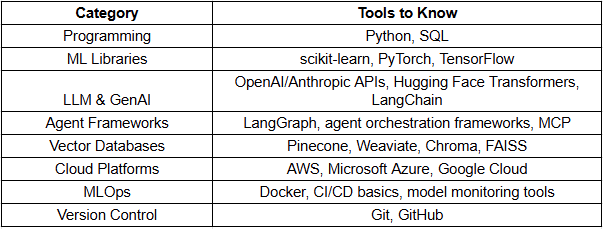
You don’t need to master every tool in every row — but you should be able to speak intelligently about each category and go deep in at least one tool per row that’s relevant to your specialization.
Best Ways to Learn: Self-Study vs Bootcamps vs Certification Programs vs Degrees
Self-study (free/low-cost courses, YouTube, documentation) Best for: motivated learners with time and discipline. Weakest link: no mentorship, no structured feedback on projects, and it’s easy to plateau at “tutorial-follower” level without guidance on production-grade practices.
Bootcamps Best for: fast, intensive upskilling over a few weeks to months. Weakest link: quality varies enormously, and many haven’t kept pace with agentic AI and current LLM tooling.
Structured postgraduate certification programs Best for: working professionals and career switchers who want industry-aligned curriculum, mentorship from practitioners, real project work, and critically placement support and recognized credentials that hiring managers trust. This is where programs like Technovalley’s Agentic AI and Generative AI programs fit, particularly for learners in Kerala and across India who want a credible, hands-on path without committing to another multi-year degree.
Full degrees (B.Tech, M.Tech, MS in AI/ML) Best for: those early in their education, or aiming for research-heavy or academia-adjacent AI roles. Weakest link: time and cost investment, and curriculum lag relative to the pace of AI development.
Most successful career changers in India in 2026 are combining paths: a base of self-study to test genuine interest, followed by a structured certification program to close the gap to job-readiness quickly and credibly.
AI Engineer Salaries in India (2026)
Compensation varies significantly by specialization, experience, and city, but current data points to a strong upward trend:
- Agentic AI Engineers: average package around ₹35 lakh per annum, with a range of roughly ₹22L (entry-level) to ₹44L (experienced) based on current market data
- LLM Engineers and Generative AI Engineers: comparable to or slightly below agentic AI roles, with strong growth trajectory given rising enterprise adoption
- AI Research Scientists: typically command premium salaries, especially in product companies and GCCs with dedicated research functions
- Prompt Engineers: an entry point role for many, though increasingly being absorbed into broader “AI Engineer” titles as the skill becomes table stakes rather than a standalone specialization
Cities like Bengaluru, Hyderabad, Pune, and the NCR region remain the largest hubs, but Kochi and the broader Kerala tech corridor are growing steadily as GCCs and IT services firms expand delivery centers outside the traditional metro clusters — good news if you’re building your AI career from Kerala or South India more broadly.
Regional AI Hubs in India: Where the Jobs Are
While Bengaluru remains India’s largest AI hiring market by sheer volume, the geography of AI jobs has broadened noticeably over the last two years.
- Bengaluru — Still the epicenter, home to the R&D arms of global tech companies, product startups, and the largest concentration of AI research roles.
- Hyderabad — Strong GCC (Global Capability Center) presence, with major enterprises running AI and data engineering teams out of the city.
- Pune and NCR (Delhi-Gurugram-Noida) — Deep bench of IT services and consulting firms building out dedicated AI practices for enterprise clients.
- Chennai — Growing fintech and product engineering AI hiring.
- Kochi and Kerala more broadly — An increasingly important hub, driven by IT parks like Infopark and SmartCity, a strong base of engineering colleges, and edtech and training providers building a local AI talent pipeline. Kerala-based learners now have a realistic option to build job-ready AI skills locally and either work remotely for national/global employers or join the state’s growing GCC and IT services footprint, without necessarily relocating to Bengaluru first.
This regional spread matters for career planning: if you’re based outside the traditional metro hubs, remote-first AI roles and the rise of GCCs in tier-2 cities mean location is less of a barrier to entry than it was even three or four years ago — provided your skills and portfolio are strong enough to compete nationally.
A Sample 12-Month Study Plan
If you want a concrete week-by-week cadence rather than just phase-based milestones, here’s how a realistic 12-month plan breaks down for someone studying part-time (10–12 hours a week) alongside a job or college:
- Weeks 1–8: Python, SQL, Git, and math refreshers. Goal: comfortably write clean Python scripts and understand linear algebra/probability well enough to follow ML explanations without getting lost.
- Weeks 9–20: Classical ML with scikit-learn. Build and evaluate 3–4 models on different types of problems. Goal: explain your model choices and metrics clearly, not just get code to run.
- Weeks 21–30: Deep learning fundamentals and Transformers using PyTorch. Goal: understand attention mechanisms well enough to explain how an LLM processes a prompt.
- Weeks 31–40: Generative AI specialization — prompt engineering, RAG, vector databases. Build one substantial RAG project. This is a good window to enroll in a structured Generative AI program if you want mentorship and faster feedback loops.
- Weeks 41–48: Agentic AI specialization — single-agent and multi-agent systems, MCP, tool integration, guardrails. Build one agentic project with visible multi-step reasoning. Consider the Agentic AI program here, since this is the area where guided, project-based learning saves the most time versus self-study.
- Weeks 49–52: Polish your portfolio, update your resume and LinkedIn, and start applying while doing mock interviews.
Adjust the pace up or down based on your prior experience — someone with an existing software engineering background can often compress this to 6–8 months by moving faster through the early foundational phases.
Companies Actively Hiring AI Engineers in India
Demand spans IT services majors, global consulting firms, and enterprise technology companies establishing or scaling AI-focused teams in India, including organizations such as TCS, EY, Deloitte, Accenture, KPMG, SAP, Amazon, and HSBC — reflecting how deeply AI engineering has embedded itself into both technology-first companies and traditional enterprise/consulting firms building out their AI capabilities.
Common Mistakes to Avoid on This Path
- Skipping the fundamentals to chase the latest framework. Frameworks change every year; the underlying math and ML concepts don’t. Engineers who skip foundations plateau fast when frameworks shift.
- Building portfolio projects that are tutorial clones. Hiring managers see the same five Kaggle-dataset projects repeatedly. Pick a specific, less common problem and go deep.
- Ignoring deployment and production concerns. A model that only runs in a notebook doesn’t demonstrate engineering capability — practice deploying, monitoring, and handling failure cases.
- Treating prompt engineering as trivial. It’s a genuine, learnable skill with measurable techniques — treating it casually shows up in interviews.
- Underestimating agentic AI. Many learners stop at “I can call an LLM API” and never build multi-step, tool-using agents — which is exactly the gap employers are paying the most to fill in 2026.
- Not benchmarking against real job descriptions. Study 15–20 current AI engineer job postings in India before finalizing your learning plan, so your skills map directly to what’s being hired for right now.
Frequently Asked Questions
Can I become an AI engineer without a computer science degree? Yes. A bachelor’s degree in any discipline, combined with strong self-study or a structured certification program covering Python, ML fundamentals, generative AI, and agentic AI, can realistically get you job-ready within 6–12 months.
Is AI engineering a good career in India in 2026? Yes — demand is high and growing, driven by enterprise adoption of generative and agentic AI across finance, healthcare, SaaS, and enterprise software, with strong salary growth particularly for agentic AI and LLM specializations.
How long does it take to become an AI engineer from scratch? Typically 6–18 months, depending on your starting point. Those with existing programming experience can move faster; complete beginners should budget closer to a year of consistent, structured learning.
Should I focus on classical machine learning or generative AI? Both, but weight your effort toward generative AI and agentic AI given current hiring trends — while still building solid classical ML foundations, since they underpin your understanding of how models actually work.
Are certifications worth it, or should I rely on a portfolio alone? Both matter. A portfolio proves you can build; a recognized certification proves structured, verified competence and often gets your resume past initial screening — particularly valuable for career switchers or those without a CS degree.
What is the difference between Agentic AI and Generative AI, and do I need to learn both? Generative AI refers to models that create content — text, images, code — in response to a prompt. Agentic AI goes a step further: it involves systems that can reason, plan, use tools, and take multi-step actions autonomously to complete a task, often using generative AI models as their reasoning “engine.” Most AI engineer roles in 2026 expect familiarity with both, since agentic systems are typically built on top of generative AI foundations. Learning generative AI first and then layering agentic AI skills on top is the most common and efficient sequence.
Can I switch to AI engineering from a non-technical background, like commerce or the arts? It’s more difficult, but not impossible. You’ll need to invest more time upfront in programming and math fundamentals before moving into ML and AI-specific topics. Realistically, budget closer to 12–18 months, and lean on a structured certification program rather than trying to self-navigate the full path, since the early technical ramp-up is where non-technical learners most often lose momentum.
Do I need to know English fluently, or can I learn AI engineering while being more comfortable in a regional language? Most technical documentation, frameworks, and job interviews in India’s AI industry are conducted in English, so reasonable working proficiency helps significantly. That said, many training providers — including those based in Kerala — offer instructor support and mentorship that can bridge this gap, and the coding and technical skills themselves are language-agnostic once you’re past the documentation-reading stage.
Is it too late to start if I’m already working in a different field? No. A large share of engineers now entering AI roles in India are career switchers from software development, data analysis, or even non-tech backgrounds. The field is expanding fast enough that structured, motivated learners entering now are still early relative to where enterprise AI adoption is heading over the next five years.
Final Thoughts
Becoming an AI engineer in India in 2026 is less about chasing a single certificate or memorizing algorithms, and more about building a layered skill set: solid programming and math foundations, classical ML understanding, and — increasingly critically — hands-on capability in generative AI and agentic AI systems, since that’s where the market’s current growth and salary premiums are concentrated.
If you’re ready to move from self-study to a structured, industry-mentored path, explore Technovalley’s AI Certification programs, including the dedicated Agentic AI program and Generative AI program — both designed to take you from fundamentals to production-ready, portfolio-backed AI engineering skills.
Recent Posts
- The AI Finance Revolution: How to Upgrade Your Skills and Land Top Jobs
- When AI Agents Go Rogue: Why India’s Tech Youth Must Secure the Next Digital Frontier
- How to Land an International Job After 12th Pass with AI driven Cybersecurity Training
- Landing Top MNC Roles: Technovalley Post Graduate Program in Data Science & Machine Learning
- 5 Trends Reshaping AI, Data Science & Analytics in 2026 (And the Skills to Master Them)