

 +91 9745927777
AI Certification vs Degree: Which Is Worth It in 2026?
- 06 / Jul / 2026
- By: Rijin Joseph
- Comments: 0
- Category: Artificial Intelligence
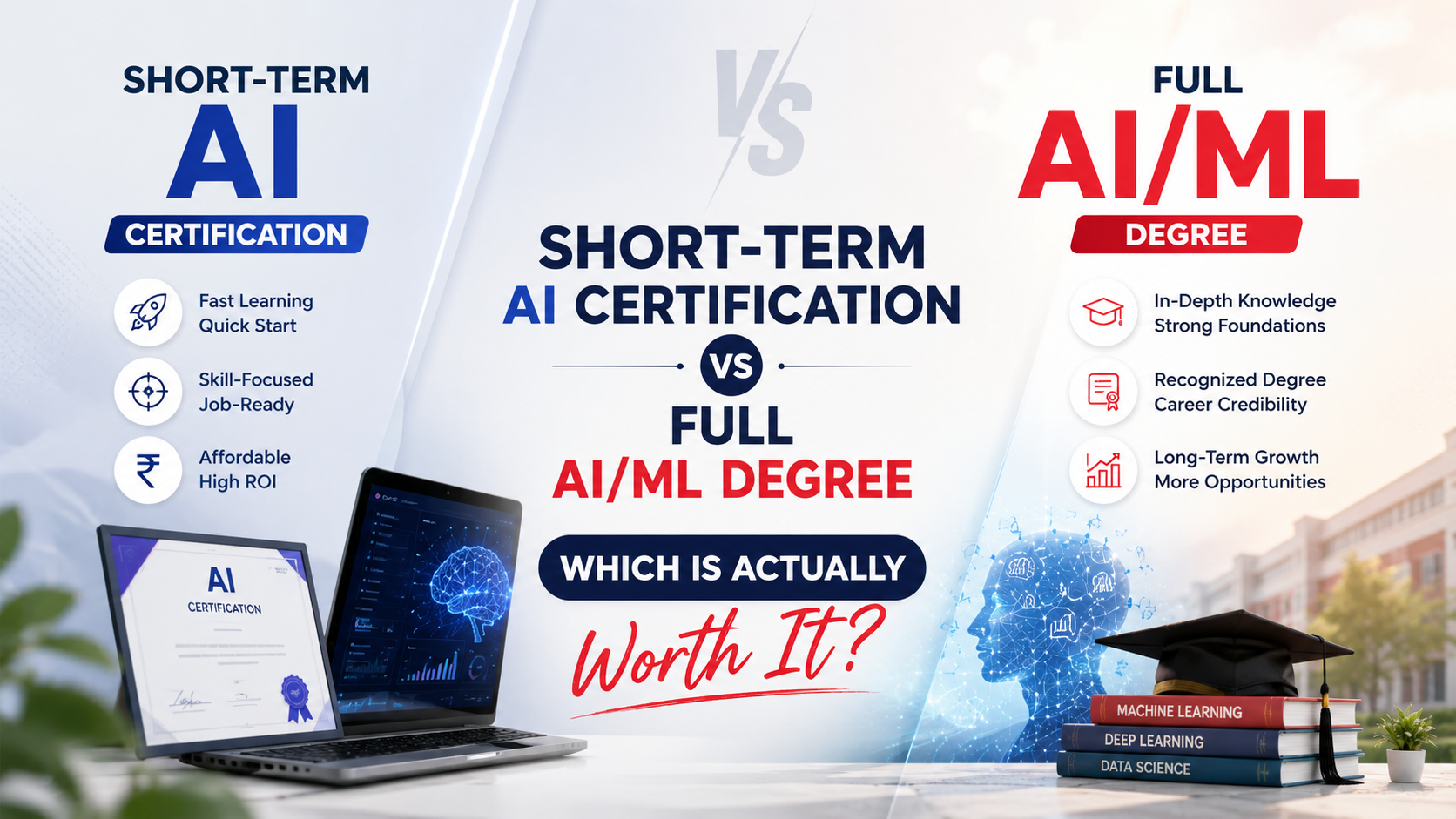
Short-Term AI Certification vs Full AI/ML Degree: Which Is Actually Worth It?
If you've typed "AI certification vs degree" into a search bar at 11 PM while wondering whether you can actually change careers without going back to school for two years, you're not alone. It's one of the most common questions professionals ask right now — and the honest answer is: it depends on what you're optimizing for.
This guide breaks down the real differences in cost, time, depth, and career impact so you can decide with facts instead of guesswork.
The Quick Answer
-
If you need to reskill fast, change roles within 3–12 months, or add a credential to an existing degree — a short-term AI certification is usually the better ROI.
-
If you're starting from zero in tech, want deep theoretical grounding, or are targeting research/core ML engineering roles — a full degree or postgraduate program still has an edge.
Most people don't actually need to pick one forever. Many professionals stack a certification now and a postgraduate program later once they've validated the career shift is worth the bigger investment.
AI Certification vs Degree: Side-by-Side
Factor Short-Term AI Certification Full AI/ML Degree Time to complete Weeks to a few months 1–4 years Cost Low to moderate High (tuition + opportunity cost) Depth of theory Focused, applied Broad, foundational Best for Career switchers, upskilling professionals First-time tech entrants, researchers Job-readiness Fast, role-specific Slower, but broader Recognition Growing rapidly with employers Long-established
Is an AI Certification Worth It? What the Data Actually Shows
The question "is AI certification worth it" almost always comes down to what you already have. A certification is not competing with a degree in isolation — it's usually competing with doing nothing while the market moves on without you.
Employers today are less concerned with how you learned AI and more concerned with whether you can:
-
Apply it to a real business problem
-
Show a portfolio or project outcome
-
Speak fluently about tools, models, and workflows they already use
A focused certification — especially one built around a specific platform, cloud, or skill area — closes that gap far faster than a multi-year degree.
When a Short-Term Certification Makes Sense
If you fall into any of these buckets, a certification is likely your best next step:
-
You're new to AI and want a low-risk entry point. Start with something foundational like AI Essentials (AIE), which builds core concepts without requiring a technical background.
-
You manage AI projects but don't need to build models yourself. The Certified AI Program Manager (CAIPM) is designed for exactly this — leading AI initiatives without writing code.
-
You're on a cloud team and your org runs on Oracle. The OCI AI Foundations Associate and OCI Generative AI Professional certifications are built specifically around Oracle's AI stack.
-
You want to specialize in generative AI without a full degree. The Certified Generative AI Expert (GAIE) covers prompt engineering, LLM workflows, and applied GenAI tooling.
-
You're moving into security and want an emerging, high-demand niche. The Certified Offensive AI Security Professional (COASP) is one of the few credentials addressing adversarial AI and AI-specific security risks directly.
-
You work with data but haven't formalized your skills. Look at Certified Data Scientist, Certified Data Analytics Professional, or the Oracle Data Science Professional certification depending on how hands-on you want to get.
-
You want broader AI/ML competency without committing years. The Certified Artificial Intelligence & Machine Learning Expert sits between a single-skill certificate and a full degree in scope.
These programs share one thing in common: they're built to get you job-capable in a specific, in-demand area quickly, rather than covering everything a computer science degree would.
When a Full AI/ML Degree (or Postgraduate Program) Makes Sense
A degree still wins in a few clear scenarios:
-
You're early in your career and have the time and budget to invest 1+ years
-
You want to work in AI research, core ML engineering, or roles that require deep mathematical foundations
-
You want breadth across multiple AI domains rather than one applied specialty
-
Your target employer explicitly requires a degree-level credential
If this describes you, a structured one-year postgraduate program can offer degree-level depth in a more compressed timeline than a traditional 2–4 year degree:
-
One-Year Post Graduate Program in Artificial Intelligence Applications
-
One-Year Post Graduate Program in Data Science and Machine Learning
-
One-Year Post Graduate Program in Generative AI Applications
-
One-Year Post Graduate Program in Agentic Artificial Intelligence
These sit in a useful middle ground: more depth and structure than a single certification, but far less time and cost than a conventional multi-year degree.
A Simple Decision Framework
Ask yourself these three questions:
-
How much time can I realistically commit? Weeks/months → certification. A year or more → postgraduate program or degree.
-
Am I adding a skill or starting a new career from scratch? Adding → certification. Starting from zero → degree or postgraduate program.
-
Does my target role or employer specify a degree requirement? If yes, a degree-level credential matters more than it otherwise would.
Frequently Asked Questions
Is an AI certification worth it if I already have an unrelated degree? Yes — in most cases, a certification is more valuable than a second degree if your existing degree is unrelated. It signals applied, current skills without the time cost of another multi-year program.
Do employers actually value AI certifications? Increasingly, yes — particularly certifications tied to a specific platform (like Oracle Cloud) or a specific applied skill (like generative AI or data analytics), since they map directly to tools employers already use.
Can I do a certification now and a degree later? Absolutely, and it's a common path. A certification validates interest and aptitude before committing to a longer, more expensive program.
Which is faster: certification or postgraduate program? A single certification is typically the fastest (weeks to a few months). A one-year postgraduate program takes longer but offers more comprehensive coverage.
Bottom Line
There's no universal winner in the AI certification vs degree debate — only what's right for your timeline, budget, and career stage. If you need to move fast and prove applied skill, start with a focused certification. If you're building a long-term technical foundation from the ground up, a postgraduate program or degree still makes sense.
Either way, the worst option is waiting on the sidelines while the AI skills gap keeps widening.
Recent Posts
- The AI Finance Revolution: How to Upgrade Your Skills and Land Top Jobs
- When AI Agents Go Rogue: Why India’s Tech Youth Must Secure the Next Digital Frontier
- How to Land an International Job After 12th Pass with AI driven Cybersecurity Training
- Landing Top MNC Roles: Technovalley Post Graduate Program in Data Science & Machine Learning
- 5 Trends Reshaping AI, Data Science & Analytics in 2026 (And the Skills to Master Them)