

 +91 9745927777
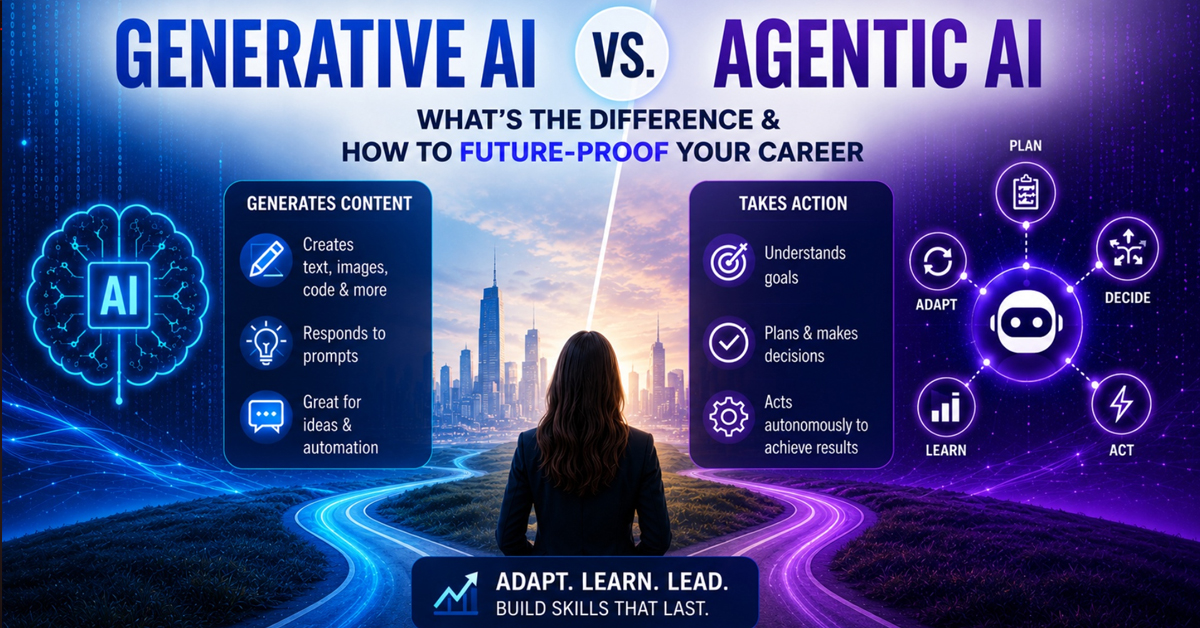
Generative AI vs. Agentic AI: What’s the Difference & How to Future-Proof Your Career
- 16 / Jun / 2026
- By: Dr. Nithesh K. N
- Comments: 0
- Category: Artificial Intelligence
The AI landscape is moving at a lightning and breakneck pace. Just as we were getting comfortable with Chat based AI tools and generating Gibili images, there was a paradigm shift. We have officially moved past the era of pure Generative AI and entered the age of Agentic AI. For an educator, researcher and user, it feels that the goalposts for AI essential tech skills is keeping moving. In 2026, simply knowing how to write a good ChatGPT prompt is no longer enough to stand out and land a job easily. In this blog we will try to break down the fundamental differences between Generative and Agentic AI, looking at the latest updates shaping the sector. The needed AI Skills as per 2026 demands are also discussed here to keep your career future-proof.
The Core Difference: Content vs. Action
To understand the scope and working of the different types of AI, we have to look at how generative and agentic AI operate in the basic level. Generative AI activates on an User Prompt allowing its background processes to be activated and ultimately generates Content/Answers/images/videos and Stops after that iteration. But an Agentic AI works by setting and understanding the User Goal, set Plans, and Uses the internal or external Tools that it is allowed to employ. It can reasons, Loop and thus Achieves its Objectives.
1. Generative AI: The Expert Creator
Generative AI is built to generate text, images, code , audio, videos etc by employing large language models (LLMs). The model takes a user prompt and generates the output based on patterns it learned during training.
- How it works: It operates on a request-and-response basis, where the user of the system asks for a service from the AI model and it gives back a preformatted, learnt generated output.
- The Limitation: It lacks autonomy as it works in the instruction of a prompt and its not taught as to the goal or purpose of the output it generated. It also lacks the power to do executions or commits like reading an email for you or to send a DM to another user on the occurrence of an event. it also doesn't have the capability to check your CRM to see if the client replied. It requires constant human intervention to initiate and also to chain tasks together
2. Agentic AI: The Autonomous Worker
Agentic AI represents a shift from passive prompting tool to active execution based on goals set. Instead of waiting for step-by-step instructions, an AI-agent is first given a high-level goal. It will require the needed digital tools also that are required to achieve the objectives.
How it works: Agents run on the system and different applications that it has access to, as an interaction for understanding or perceiving , do reasoning and planning. Based on this it will execute the action that is needed for achieving the objective set. For example, if an Agentic AI system is tasked with finding all broken links on our website, and to describe needed corrections for each, and log them in the Jira board," it will independently navigate the web, use APIs, self-correct its errors, and complete the job. The major difference here is that agents possess autonomy, memory, and external application-use capabilities
Comparison Tabulation- Gen AI v Agentic AI
| Feature | Generative AI | Agentic AI |
| Primary Function | Content creation & answering queries | To execute and achieving complex, multi-step goals |
| User Inputs need | Specific prompts are needed in Step-by-step fashion | High-level objectives and guard rails are set at the onset. |
| Autonomylevel | Is Low or non-existent and always requires human-in-the-loop) | Is High and has Self-directing and self-correcting capabilities. |
| Tools that are used | It uses the internally trained knowledge base | It uses RAG based system which employs the internal knowledge ,External APIs, internet browsers, & any softwares supported by the model |
The 2026 agentic AI Landscape- How the shift happened?
The shift toward agentic workflows can be considered as a major revision in LLM architecture and the framework rethinking itself that have accelerated the massive rise of such agents. Today's latest and cutting-edge models like that from Anthropic or other similar models are no longer judged solely on how well they write a poem or essay. Instead, they are specifically engineered for advanced reasoning, deep thinking and sequential planning. They have the ability to dissect massive problems into smaller tasks, use external coding environments & applications. It can test their own solution that it has churned out, and double-check the application and logic before presenting a final result. Because AI can execute and do action, all the major companies are aggressively shifting their focus from building and using basic generative tools to complex agentic frameworks.
Recent Posts
- The AI Finance Revolution: How to Upgrade Your Skills and Land Top Jobs
- When AI Agents Go Rogue: Why India’s Tech Youth Must Secure the Next Digital Frontier
- How to Land an International Job After 12th Pass with AI driven Cybersecurity Training
- Landing Top MNC Roles: Technovalley Post Graduate Program in Data Science & Machine Learning
- 5 Trends Reshaping AI, Data Science & Analytics in 2026 (And the Skills to Master Them)