

 +91 9745927777
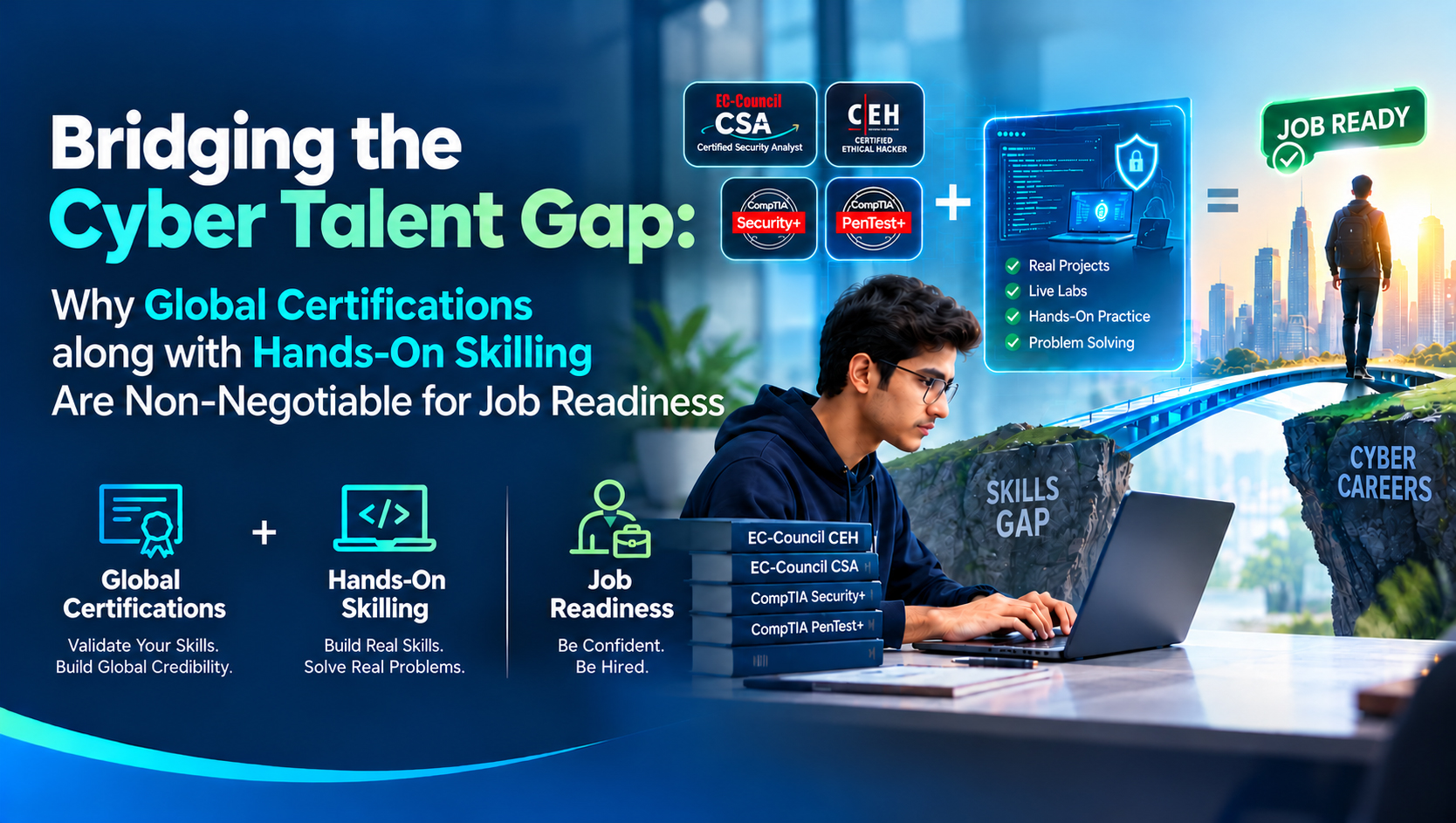
Bridging the Cyber Talent Gap: Why Global Certifications along with Hands-On Skilling Are Non-Negotiable for Job Readiness
- 10 / Oct / 2026
- By: Dr. Nthesh K N
- Comments: 0
- Category: Cyber Security
The cybersecurity industry as seen now is facing a never before seen paradox: thousands of open roles globally as posted in the many job offerings seen online, and yet thousands of fresh graduates are struggling to get hired.
Why is this happening? Because enterprise security demands immediate operational capability. Academic degrees and even mere certifications establish critical theory, but hiring managers need analysts who can analyze and contain a live ransomware attack or analyze suspicious network traffic on Day 1.
The bridge across this gap combines accredited global certifications with rigorous, hands-on application.
Remember the Core Reality Check- A global certification along with graduation or not will open the door to an interview, but practical competence secures the offer letter.
The Strategic Value of Global Certifications
Global vendor-neutral certifications especially in cybersecurity domains such as CompTIA Security+, EC-Council CEH v13 (AI), Certified SOC Analyst (CSA), CHFI etc. are the golden certifications and serve as the global language of technical trust by corporations. The values that are added includes-
- Standardized Benchmarking: Certifications validate your understanding of globally recognized security frameworks like NIST, MITRE ATT&CK, and ISO/IEC 27001, which form the basis of quality assurance in such organizations.
- Employer Confidence: Currently its observed that hirers use accredited credentials to screen candidates quickly. This will ensure that the applicant has met established industry standards.
- Structured Skill Progression: Pathways in certified programs following a structured syllabus that is up to date will systematically advance your advertised capabilities. This will allow you to move from core network defense to specialized red teaming, blue teaming, or digital forensics.
However, passing a multiple-choice exam that is seen in the pattern for such cybersecurity certification programs is only half the equation. The real test happens when an active threat hits the network.
How Technovalley Programs Build True Job Readiness
Programs by Technovalley Software India AKS division bridge the gap between theoretical certification knowledge and operational execution through an industry-aligned learning model:
Starting from the Academic Foundation that will cement your foundation in IT and cybersecurity to Hands-On Practice including more than 70% Practical with Live Threat Labs and Global Vendor Certification like that offered by CompTIA, EC-Council in half the step. Industry Internships & Mentorship along with soft skills training making you interview ready is the biggest next step that will carve you to become an Enterprise-Ready Cybersecurity Professional
Key Pillars of the Technovalley Approach:
1. More impetus on Practical and Live Threat Labs
2. Students work inside simulated cyberattack environments provided by different cybersecurity simulation applications that uses real enterprise tools like-
- Offensive Security: Penetration testing with Nmap, Metasploit, Burp Suite, and Wireshark.
- Defensive SOC Operations: Log analysis, threat hunting, and triaging with SIEM platforms like Splunk and Elastic.
- Digital Forensics: Extracting artifacts and memory dumps using Autopsy and FTK Imager.
3. AI-Driven Threat Detection Integration
4. With threat actors adopting AI, defenders must evolve. Technovalley incorporates updated global frameworks. In the case of CEH v13 , students learn to leverage AI tools for automated threat detection, incident triage, and defensive reconnaissance.
5. Integrated Global Certification Alignment with the reputed organizations in the industry 6. Preparation for credentials like CompTIA Security+, CEH, CSA, and CHFI is baked directly into the hands-on curriculum—ensuring students earn globally recognized badges alongside practical experience. 7. Live Internships & Career Support with placement training /interview mocks.
It's your turn now!
Don't stop at reading the curriculum and textbooks or just earning certificates. Combine accredited global credentials with the intended hours of live lab practice and real-world tools to turn your resume into a job-ready portfolio.
If you're currently trying to enter into cybersecurity, what's the single biggest challenge you see in today's candidate landscape? Let’s discuss in the comments below!
Recent Posts
- Bridging the Cyber Talent Gap: Why Global Certifications along with Hands-On Skilling Are Non-Negotiable for Job Readiness
- Cybersecurity Roadmap 2026: From Beginner to Job-Ready
- The AI Finance Revolution: How to Upgrade Your Skills and Land Top Jobs
- When AI Agents Go Rogue: Why India’s Tech Youth Must Secure the Next Digital Frontier
- How to Land an International Job After 12th Pass with AI driven Cybersecurity Training