

 +91 9745927777
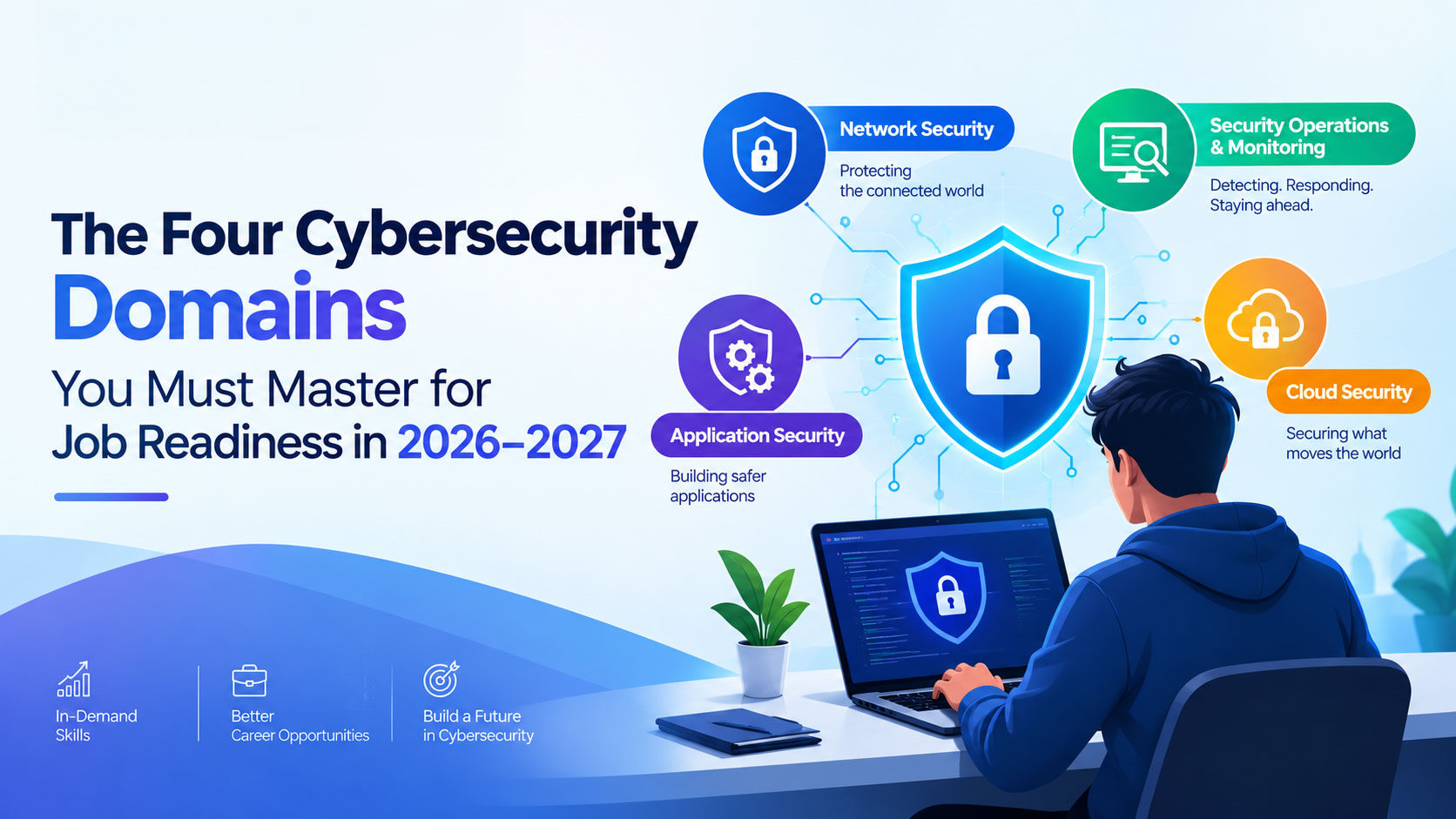
The Four Cybersecurity Domains You Must Master for Job Readiness in 2026–2027
- 28 / Sep / 2026
- By: Dr. Nthesh K N
- Comments: 0
- Category: Cyber Security
The cyber threat landscape is evolving faster than traditional security training syllabus can keep up. Between AI-powered malware, multi-cloud malwares, and new sophisticated state-sponsored attacks, staying employable in cybersecurity requires moving past static perimeter defence.
To secure a high-growth profile and to future-proof your existing career, these are the four critical domains you must master right now.
1. AI-Powered Offensive & Defensive Security
Artificial Intelligence is now a double-edged sword in cybersecurity. Threat actors are leveraging generative AI tools for crea worms and fraudwares to create polymorphic malicious apps used to bypass traditional filters. Security Operations Centers (SOCs) has to now rely on AI-assisted tools to automate threat triage and detect anomalies in real time.
You need training in Key Focus Areas like Prompt injection vulnerabilities, automated vulnerability scanning using tools like DeepExploit, and building AI-enhanced defensive workflows.
2. Next-Gen SOC Operations & Threat Intelligence
SOC operations need moving away from manual log parsing and demand analysts who understand automated Incident Response (IR), Threat Intelligence integration (IoCs), and extended detection capabilities. To be in this domain means knowing how to manage SIEM alerts, execute fast threat hunts, and contain breaches before they hit critical systems.
Get hands on in tools involving SIEM monitoring, log analysis, threat hunting, and automated Incident Response (IR) workflows.
3. Offensive Security & Multi-Platform Penetration Testing
The new mobile , web and cloud infra has dissolved the perimeters in digital information sharing and due to that ethical hacking in 2026 demands more than running surface scans. It further requires deep hands-on exploitation, privilege escalation, know how to do shell scripting, and evaluating edge systems like IoT and Android applications.
Web and mobile app penetration testing, shell scripting, Metasploit frameworks, bug hunting, and wireless/IoT security are the key domains that need mastery.
4. Digital Forensics & Incident Response (DFIR)
Breaches always happens, and it needs fast investigation and evidence preservation. Employers are actively hiring professionals who can perform digital evidence collection, conduct deep-dive email and application forensics. Also tracking attack pathways across complex network architectures is crucial
If you need proficiency in these get trained in Memory and disk forensics, digital evi
To meet these market demands, Technovalley Software India which is an audence collection, network traffic analysis, and post-breach investigation.
Bridge the Skill Gap with Technovalleythorized ECCouncil Accredited Training Partner Microsoft and OffSec partner in India offers industryaligned training programs built around practical, real-world execution. These are the key programs that will help you to achieve these goals -
- CEH v13 (AI Edition): Master AI-powered offensive and defensive security strategies, hands-on vulnerability analysis, and exposure to tools like ShellGPT, ChatGPT, and DeepExploit for threat detection.
- EC-Council Certified SOC Analyst (CSA): Train in immersive security labs using modern SIEM technologies, real-time threat detection, and automated SOC workflows.
- OffSec Program (SOC-100 / SOC-200): Build practical skills in offensive cybersecurity, defensive analysis, and penetration testing methodologies.
- Diploma and PG in Information Security & Forensics: Gain end-to-end expertise spanning web application security, Android penetration testing, shell scripting, and digital forensic investigations.
- CompTIA Tech+: Lay the technical foundation in hardware, networking, virtualization, and cloud security fundamentals for early-career roles.
Which all cybersecurity domains are you prioritizing in 2026? Drop your thoughts in the comments below!
Recent Posts
- Landing Top MNC Roles: Technovalley Post Graduate Program in Data Science & Machine Learning
- 5 Trends Reshaping AI, Data Science & Analytics in 2026 (And the Skills to Master Them)
- Building the Agentic AI Workforce: Bridging the Data Gap with Technovalley
- The Four Cybersecurity Domains You Must Master for Job Readiness in 2026–2027
- Is your STEM degree enough to bridge the AI execution gap?- Elevate your career to become global AI Architects