

 +91 9745927777
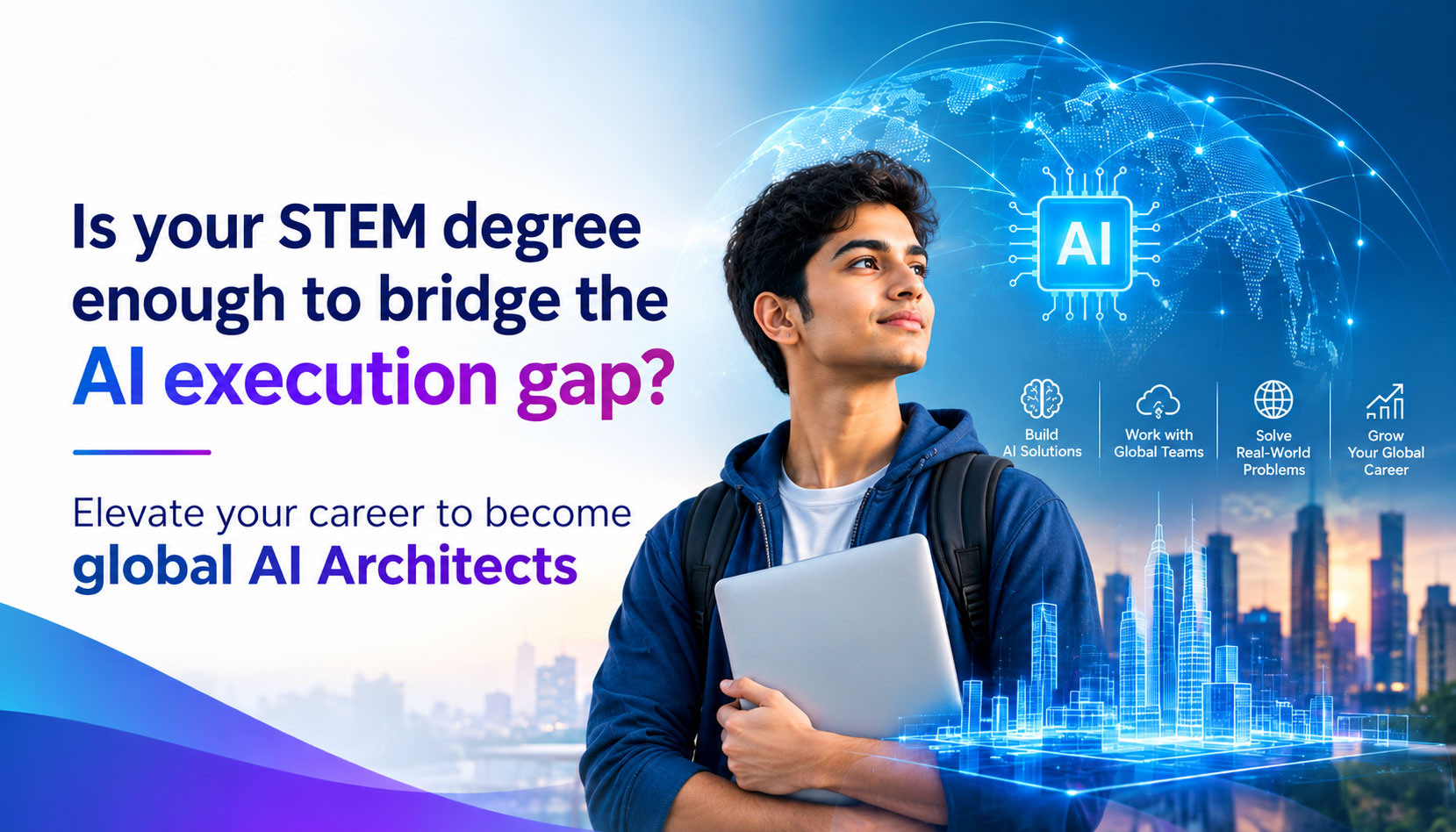
Is your STEM degree enough to bridge the AI execution gap?- Elevate your career to become global AI Architects
- 25 / Sep / 2026
- By: Dr. Nthesh K N
- Comments: 0
- Category: Artificial Intelligence
India produces over 1.5 million science and engineering graduates annually, yet enterprise leaders face a persistent shortage of production-ready AI talent. While university syllabi for different courses including B.Tech, B.Sc,BCA, M.Sc or MCA will provide strong theoretical foundations, graduates frequently struggle to build, deploy, and scale enterprise AI systems, which is a must wanted skill that every employer is seeking for.
The 4 Main Hurdles in the University Ecosystem
- Rote Learning vs. Production Engineering: Curricula focus at Technovalley will be based on exam-based theory and isolated code snippets. Graduates can write algorithms on paper or run toy ML models in Jupyter Notebooks, but lack experience in doing the real AI enterprise data pipelines or live deployments that need proper industry-experienced guidance.
- Syllabus Lag: University update cycles take 3–5 years. Coursework centers on legacy statistical Machine Learning techniques and is actually missing the rapid shift the industry is moving towards Generative AI, Large Language Models (LLMs), RAG, and Agentic Frameworks.
- Missing MLOps Infrastructure: Engineering labs still give grades and evaluate the progress of students by verifying the single-file scripts or program codes that they have created in a linear fashion that is very much different from what actually transcribes in an industry setup. Real production software engineering procedures are needed to be learnt by the graduates. Graduates enter the workforce without exposure to model containerization like using Docker, cloud orchestration by using Azure or AWS, or production APIs like the one provided by FastAPI.
- Branch Disparity: Core engineering academic sessions including Mechanical, Civil, Electrical etc. and pure science graduates are often excluded from AI roles due to a lack of practical software development exposure in their degree coursework.
How Technovalley AI Programs Solve the Gap
Technovalley is an industry leader in Cybersecurity and AI training and has replaced passive University learning with an execution-first framework that bridges academic theory and production capabilities.Its very unlike to that of higher education as it relies on exam proofs, isolated notebooks, and legacy statistical AI and ML models that run on local machines. Technovalley delivers a 70% practical, lab-first ecosystem centered on modern AI toolkits like PyTorch, LangChain, LlamaIndex, CrewAI, and Vector Databases.
Instead of leaving students with a text based and fixed curriculum that provides just local execution skills, Technovalley academic programs teach full end-to-end MLOps using AI. This includes model containerization with Docker, API development with FastAPI, and cloud deployment on AWS. Crucially, this execution model breaks down siloed departmental barriers, providing an inclusive STEM pipeline that equips core engineering and pure science graduates alongside CS majors to build and deploy enterprise-grade AI solutions.
Technovalley advanced tracks includes various short term and long term academic programs with practical hands-on focus and will be a much needed leveller for the pitfalls due to University education . Programs including the PG Program in Agentic AI, PGP in AI Applications, and Technovalley Certified AI & ML Expert, will all help to replace passive learning with an execution-first framework.
By bridging the divide between mere byhearting models even for IT programs, or showing excellence by getting academic marks only with no industry ready production capabilities, and the capabilities that students build by the practical oriented high tech new age programs that Technovalley offer , this premium institution turns STEM graduates into skilled engineers who can build, orchestrate, and deploy next-generation AI solutions
Recent Posts
- Landing Top MNC Roles: Technovalley Post Graduate Program in Data Science & Machine Learning
- 5 Trends Reshaping AI, Data Science & Analytics in 2026 (And the Skills to Master Them)
- Building the Agentic AI Workforce: Bridging the Data Gap with Technovalley
- The Four Cybersecurity Domains You Must Master for Job Readiness in 2026–2027
- Is your STEM degree enough to bridge the AI execution gap?- Elevate your career to become global AI Architects