

 +91 9745927777
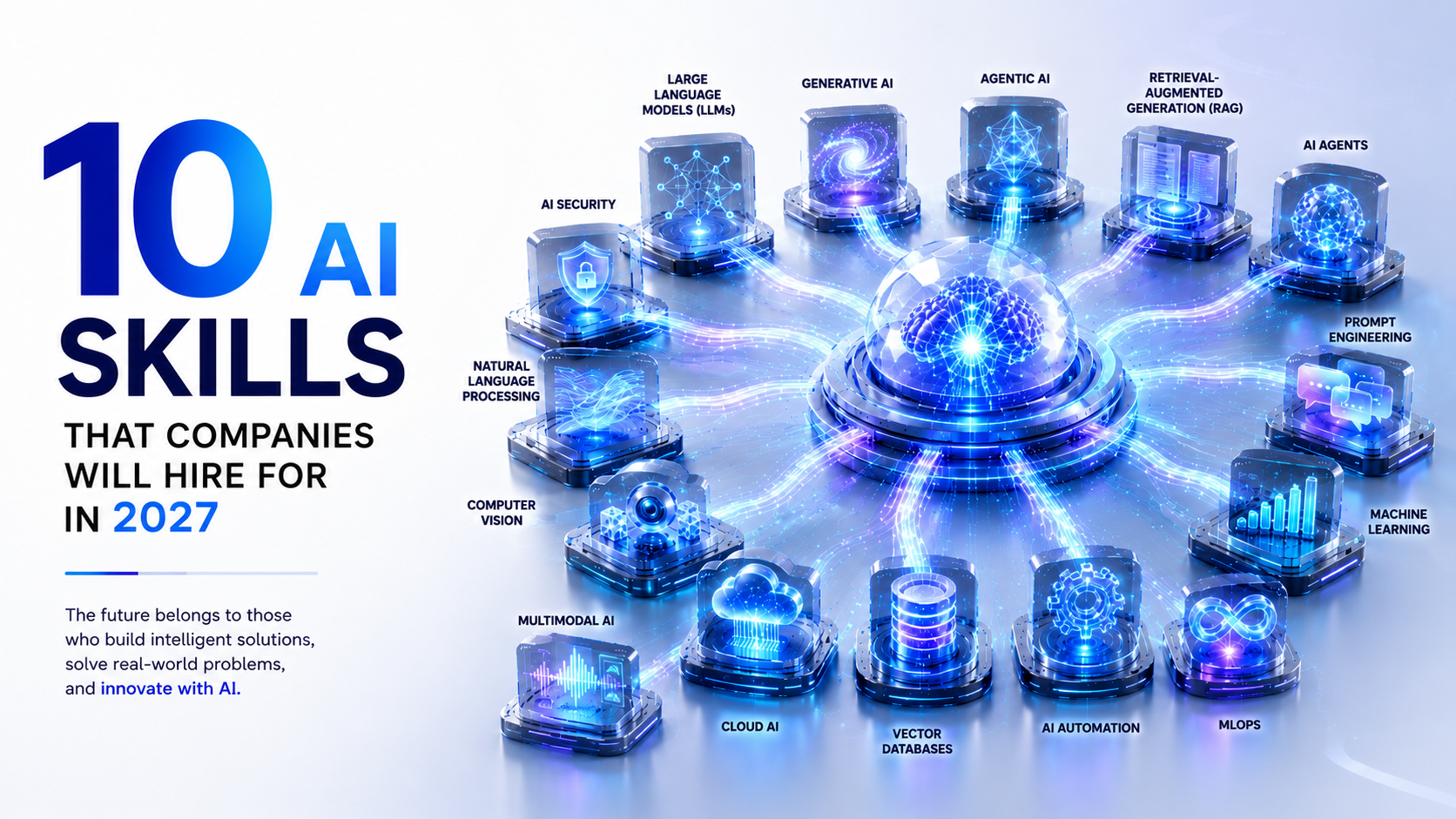
10 AI Skills That Companies Will Hire for in 2027
- 03 / Jul / 2026
- By: Rijin Joseph
- Comments: 0
- Category: Artificial Intelligence
AI hiring has moved through several distinct phases in just a few years — first it was "know how to use ChatGPT," then "know how to prompt well," then "know how to build with LLMs." As we head into 2027, the bar has risen again. Gartner projects that 80% of enterprise engineering workforces will need upskilling specifically for AI collaboration by 2027, and IBM has projected that around 40% of professionals will need to learn new skills by 2027 just to keep pace with how AI is transforming the workplace. That's not a niche shift — it's a full recalibration of what "employable" looks like across both technical and non-technical roles.
At the same time, the labor market data tells a more nuanced story than "AI takes jobs." PwC's 2026 Global AI Jobs Barometer, analyzing over a billion job ads across six continents, found that AI is creating a two-track labour market in which skills like judgement and leadership are even more critical and more rewarded. Productivity growth is running 40% higher at companies most exposed to AI compared to those least exposed, and — notably — those same companies are raising both wages and headcount faster than companies with less AI exposure. In other words, AI isn't shrinking the job market for skilled people; it's raising the price of the specific skills that let people work effectively with it.
This guide breaks down the 10 skills most likely to define AI hiring in 2027 — not vague buzzwords, but the specific, learnable capabilities showing up in job postings, analyst reports, and enterprise hiring plans right now.
1. Agentic AI Development and Agent Orchestration
If there's one category dominating forward-looking hiring reports, it's this one. Enterprises have moved past experimenting with single chatbots and are now deploying systems of AI agents that plan, use tools, and execute multi-step work with limited supervision. Deloitte has flagged the rise of dedicated "Agent Ops" roles in enterprises, focused specifically on coordinating teams of AI agents to execute complex workflows.
By 2027, expect this to be one of the clearest, highest-paid specializations in the AI hiring market. Companies need engineers who can:
-
Design multi-agent systems where specialized agents hand off subtasks to one another
-
Integrate agents with real business tools and data sources using standardized protocols
-
Build observability and guardrails so autonomous systems fail safely rather than silently
-
Debug agent behavior that's probabilistic rather than strictly deterministic
This is exactly the skill set covered in Technovalley's Agentic AI program, which takes learners from agent architecture fundamentals through multi-agent orchestration and production deployment — the core of what "Agent Ops" hiring will look for.
2. Context Engineering (The Successor to Prompt Engineering)
Prompt engineering was the breakout AI skill of the early generative AI era. It's now being absorbed into something broader and more demanding: context engineering. Gartner analysts describe context engineering as the ability to structure inputs, constraints, domain knowledge, and output expectations in a way that consistently produces reliable AI results — and critically, this requires being a subject matter expert first, since a generalist who knows how to prompt will always be outperformed by a domain expert who knows how to prompt.
By 2027, "can write a good prompt" will be table stakes, not a differentiator. What companies will actually hire for is the ability to engineer entire context pipelines — retrieval systems, structured knowledge, tool definitions, memory — that make AI outputs reliable at scale in a specific business domain.
3. AI Governance, Trust, and Risk Management
As AI systems take on more autonomous responsibility, the cost of getting them wrong rises sharply — and regulation is catching up. In May 2026, EU lawmakers reached a provisional agreement to overhaul key parts of the AI Act, pushing back enforcement of high-risk AI system obligations to December 2027, with an extended deadline to August 2028 for AI systems classified as regulated products or safety components. That timeline puts 2027 squarely in the window where governance skills go from "nice to have" to "compliance requirement."
Demand is growing for professionals who understand how to manage AI systems within structured governance frameworks, driven by ongoing challenges around data privacy, algorithmic transparency, accountability, and regulatory compliance. Lead Auditors specialized in frameworks like ISO/IEC 42001 are playing a growing role in evaluating AI management systems, identifying compliance gaps, and ensuring AI initiatives align with regulatory expectations. One analyst put it bluntly: "the most valuable AI skill in 2026 is not coding, it is building trust" — and that framing only gets more relevant as regulatory deadlines approach through 2027 and 2028.
4. AI System Architecture and Judgment
As AI tools handle more of the actual implementation work, the human value shifts upward — to architecture, tradeoff decisions, and judgment calls that can't be automated. The engineers who will be most valuable over the next three to five years are those who can hold a system's architecture in mind and make confident decisions about tradeoffs, not those who are fastest at producing syntax. As AI handles a growing share of implementation, the decisions that remain human are architectural and design questions — what should be built, how systems interact, and where automation is appropriate versus where it introduces unacceptable risk.
This is a genuinely different skill from "knowing frameworks." It requires deep technical grounding plus the confidence to make and defend design decisions — which is exactly why system design is increasingly a core part of AI engineering interviews, not just an add-on for senior roles.
5. Retrieval-Augmented Generation (RAG) and Enterprise Knowledge Integration
Generic, off-the-shelf LLMs aren't enough for most enterprise use cases — businesses need answers grounded in their own proprietary data. Fine-tuning open-source models on domain-specific data and building RAG pipelines that fetch context in real time from internal knowledge bases have become core techniques for making models smarter, safer, and highly specific to business needs. Practically, this means being able to configure vector databases for semantic search and document retrieval, and optimize performance across latency, token limits, and memory constraints.
This skill set will remain foundational well into 2027, since it's the mechanism that lets every other AI application — chatbots, agents, copilots — actually work with an organization's real, current information rather than generic training data. Technovalley's Generative AI program builds this capability hands-on, covering embeddings, chunking, vector databases, and RAG pipeline design as core curriculum.
6. Multimodal AI Systems Engineering
Text-only AI is quickly becoming the exception rather than the rule. Combining language, audio, vision, and sensor data into more adaptable, real-time applications is a rising need, and companies building the next generation of AI products — from customer service to industrial monitoring — increasingly need engineers who can design systems that reason across multiple data types at once, not just text.
By 2027, expect multimodal fluency to move from a specialized, research-adjacent skill to a mainstream expectation for engineers building consumer-facing or operationally embedded AI products — anywhere a system needs to understand images, audio, video, or sensor data alongside text.
7. Machine Learning Engineering at Production Scale
Despite all the attention on generative and agentic AI, classical ML engineering hasn't gone anywhere — it remains the backbone of most deployed AI systems. Companies no longer need data scientists who just experiment; they need machine learning engineers who can translate messy real-world data into deployed models that drive measurable outcomes, spanning everything from churn prediction to recommendation systems. That means being able to engineer features from transactional, behavioral, or sensor data, train and evaluate models for accuracy, robustness, and speed, and package models into deployable assets like APIs, batch jobs, or applications.
This skill will remain in steady, high demand through 2027 precisely because it's less flashy than agentic AI — but every agentic or generative system still relies on solid classical ML and data engineering underneath it.
8. AI Security and Guardrail Engineering
As AI systems gain more autonomy and access to real business systems, the attack surface — and the cost of failure — grows with it. Security-focused AI skills are shifting from a specialized niche to a baseline expectation for anyone building agentic or production-facing AI systems: designing guardrails that prevent an autonomous agent from taking a harmful or costly action, building monitoring that catches anomalous behavior before it causes damage, and hardening systems against prompt injection and other AI-specific attack vectors.
This skill pairs closely with AI governance (skill #3), but it's distinct — governance is about policy, accountability, and compliance frameworks, while guardrail engineering is about the actual technical controls that keep autonomous systems safe in production. Expect roles explicitly combining "AI engineer" and "AI security" responsibilities to become far more common by 2027 as agentic deployments scale.
9. Human-AI Collaboration and Leadership Skills
It might seem counterintuitive that "soft skills" make a list of technical AI hiring trends, but the data is unambiguous on this point. Skills needed for the most AI-exposed jobs are changing more than twice as fast as for the least AI-exposed jobs, and jobs "professionalised" by AI — reshaped to require even more human expertise — are growing twice as fast as jobs "democratised" by AI, with 42% faster wage growth since 2021. Even more striking: the most AI-exposed junior roles are seven times more likely than the least AI-exposed junior roles to demand traditionally senior skills like leadership.
In practice, this means the traditional career ladder is compressing — junior professionals in AI-exposed roles are increasingly expected to exercise judgment, strategic thinking, and leadership far earlier than prior generations were. Employers screening AI talent in 2027 will weight communication, cross-functional collaboration, and decision-making under uncertainty as heavily as technical depth, not as a tiebreaker but as a core hiring criterion.
10. Applied Domain Expertise Combined with AI Fluency
The final skill on this list isn't a standalone AI capability — it's the combination that increasingly beats pure AI generalism. A generalist who knows how to prompt will always be outperformed by a domain expert who knows how to prompt, and this pattern is showing up across industries. Manufacturing shows a higher percentage of job ads requiring AI skills than other industries with more general AI exposure, like financial services, suggesting companies are investing heavily in embedding AI into domain-specific operations — and Professional Services, including consulting and legal services, is seeing fast-growing demand for AI-skilled talent as AI integrates deeper into traditionally non-technical work.
By 2027, the most competitive candidates won't be AI generalists competing purely on tool knowledge — they'll be legal professionals who deeply understand AI-powered contract review, healthcare specialists fluent in clinical AI tools, or finance professionals who can architect AI-driven risk models. If you already have deep expertise in a specific field, layering AI fluency on top of it — rather than starting from scratch as a pure AI generalist — may be the single highest-leverage career move available to you.
How to Start Building These Skills Now
Reading a list like this is useful, but 2027 isn't far away — the engineers and professionals who'll be well-positioned for it are the ones building these skills over the next 6–18 months, not waiting until the hiring trend is fully mainstream.
A practical starting sequence:
-
Build core AI/ML foundations if you don't already have them — programming, statistics, and an understanding of how modern models actually work.
-
Go deep on generative AI and RAG — prompt engineering, context engineering, embeddings, and retrieval pipelines, since this underpins nearly every skill on this list.
-
Move into agentic AI — agent architecture, multi-agent orchestration, and the safety/guardrail practices that go with autonomous systems.
-
Layer in governance and security awareness, even if you're not pursuing a dedicated compliance role — understanding these frameworks is increasingly expected of anyone building production AI systems.
-
Don't neglect your domain expertise or your soft skills — the data is clear that judgment, leadership, and applied domain knowledge are being rewarded at least as much as raw technical AI skill.
If you want a structured, mentored path rather than piecing this together from scattered resources, Technovalley's AI Certification programs are built around exactly this trajectory — with the Generative AI program covering the context engineering and RAG foundations, and the Agentic AI program covering agent orchestration, tool integration, and the guardrail practices that Agent Ops roles will demand by 2027.
Frequently Asked Questions
Will these skills replace coding as the core AI job requirement? Not replace — reposition. As of early 2026, AI tools are already involved in nearly half of all code written in enterprise environments, yet demand for strong engineers hasn't dropped — it has grown, because the bottleneck has shifted from writing code to directing, verifying, and building systems around AI output effectively. Coding remains essential; it's just no longer sufficient on its own.
Is agentic AI really going to be as big as the reports suggest? Current data points strongly in that direction. Agent-focused roles like "Agent Ops" are already appearing in enterprise hiring plans, and the broader trend toward multi-step autonomous AI systems shows no signs of slowing as enterprises look to scale AI beyond simple chat interfaces.
Do I need to become a specialist in all 10 of these skills? No — trying to master all ten simultaneously is a recipe for shallow competence across the board. Pick one or two technical specializations (most learners should start with generative AI and/or agentic AI) and layer governance awareness, security fundamentals, and strong communication skills on top, rather than treating all ten as equally weighted priorities.
How much of this applies to non-technical professionals? A significant amount. Skills like context engineering, AI governance awareness, and — especially — combining domain expertise with AI fluency are highly relevant to non-technical roles in law, healthcare, finance, and operations. You don't need to become an engineer to benefit from understanding how these systems work and where they fit into your existing expertise.
Recent Posts
- Elevating Tech Careers: The Strategic Value of Accredited Institution Certification Programs in IT
- What Is Agentic AI? A Beginner's Guide for 2026
- From Learning to Launch: Building a High-Tech AI Career & Startup in 2026
- Best AI Certifications for Freshers vs Working Professionals in 2026
- Technovalley Is a Microsoft Global Training Partner Across 5 Countries: What It Means for Your AI Career