

 +91 9745927777
Data Science vs AI vs Machine Learning: Which Course Should You Actually Choose?
- 06 / Jul / 2026
- By: Saniyo Mathew
- Comments: 0
- Category: High impactful
Data Science vs AI vs Machine Learning: Which Course Should You Actually Choose?
Search "data science vs AI vs machine learning course" and you'll get a dozen definitions, three Venn diagrams, and zero clarity on which one actually gets you hired. That confusion is completely reasonable — the three fields overlap so much in job postings that even hiring managers use the terms loosely.
This guide cuts through the overlap and gives you a straight answer: what each field actually involves, how the courses differ, and which one matches your specific goal.
The Short Version
-
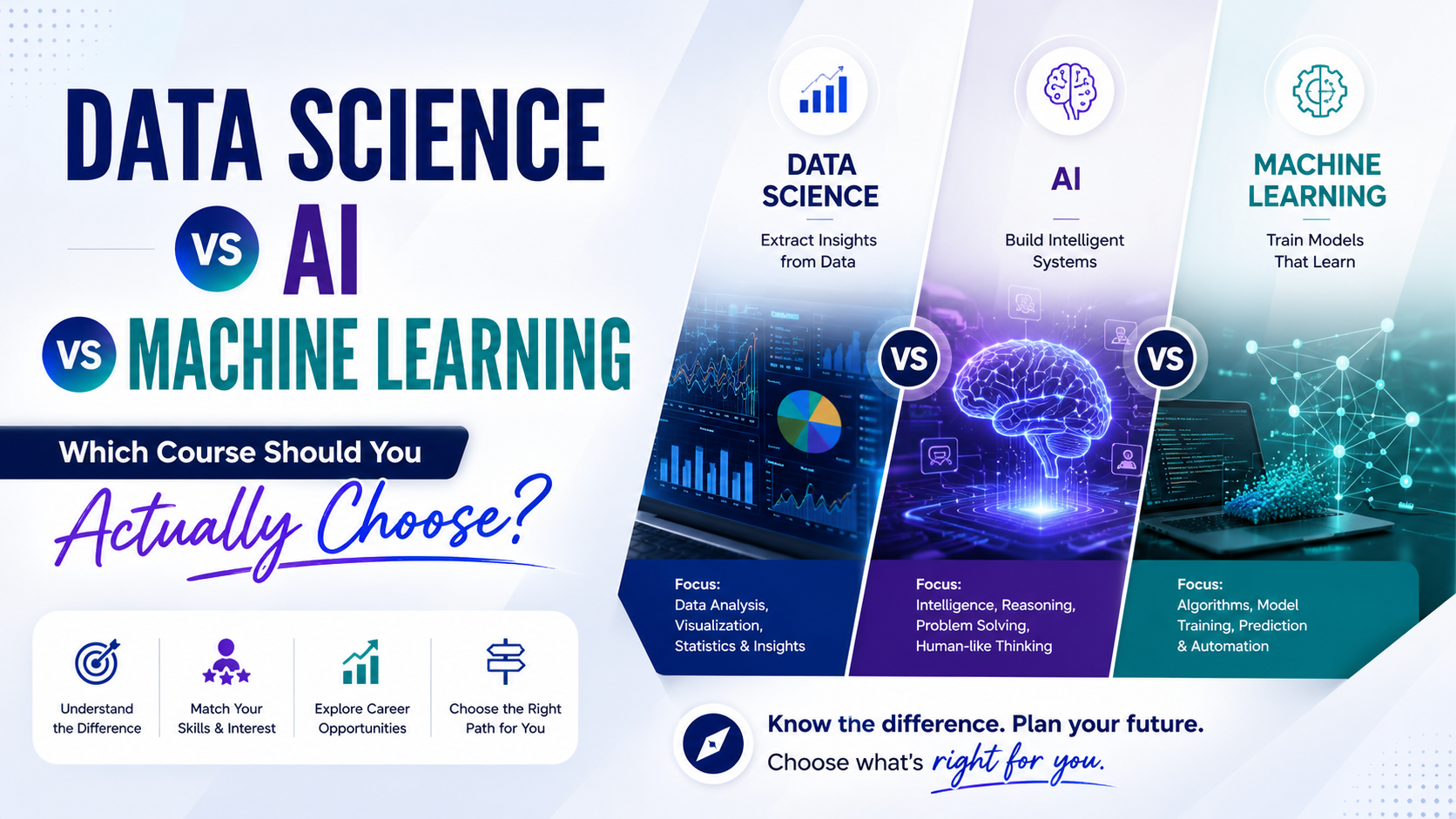
Data Science = extracting insights and decisions from data (stats, analysis, visualization, some ML)
-
Machine Learning = building the algorithms and models that learn patterns from data
-
Artificial Intelligence = the broader umbrella that includes ML, plus reasoning, generative systems, agents, and automation
Think of it as layers: AI is the umbrella. Machine Learning is a method inside that umbrella. Data Science is the practice of using data — including ML — to solve business problems.
Almost every real job blends at least two of these. The real question isn't "which field is better" — it's "which skill set does the role I want actually require?"
Breaking Down Each Field (and What the Courses Actually Teach)
Data Science
Data science courses focus on turning raw data into decisions: statistics, data cleaning, visualization, SQL, and increasingly, applied ML models for prediction. This is the right lane if you enjoy working with numbers, dashboards, and business questions more than building the underlying algorithms yourself.
Relevant programs:
-
Technovalley Certified Data Scientist — core data science skills, applied and project-based
-
Certified Data Analytics Professional — a lighter-weight option if your focus is analytics and reporting rather than modeling
-
Oracle Data Science Professional — ideal if your organization runs on Oracle Cloud infrastructure
-
One-Year Post Graduate Program in Data Science and Machine Learning — for a full-depth, degree-equivalent path
Machine Learning
ML courses go deeper into the technical side: algorithms, model training, evaluation, and increasingly, how models are deployed in production. This is the right lane if you want to build the models rather than just use their outputs.
Relevant programs:
-
Technovalley Certified Artificial Intelligence & Machine Learning Expert — covers both AI concepts and hands-on ML model building
-
One-Year Post Graduate Program in Data Science and Machine Learning — same program as above; it's built to cover both disciplines together, which reflects how they're used together on the job
Artificial Intelligence
AI courses cover the broader landscape: how AI systems reason, how generative models work, how AI is applied across business functions, and — increasingly — how autonomous AI agents operate. If you want breadth, strategic understanding, or you're aiming for a leadership or generalist AI role, this is the wider lane.
Relevant programs:
-
AI Essentials (AIE) — the best starting point if you're new to AI concepts altogether
-
Certified AI Program Manager (CAIPM) — for managing AI initiatives without needing to build models yourself
-
OCI AI Foundations Associate — foundational AI concepts on Oracle Cloud
-
One-Year Post Graduate Program in Artificial Intelligence Applications — comprehensive, applied AI across multiple domains
Generative AI and Agentic AI (the newer branch)
If your interest leans toward large language models, chatbots, content generation, or autonomous AI agents, this now sits as its own specialization distinct from "classic" AI/ML coursework.
Relevant programs:
-
Certified Generative AI Expert (GAIE) — applied GenAI and prompt engineering
-
OCI Generative AI Professional — GenAI specifically within the Oracle Cloud ecosystem
-
One-Year Post Graduate Program in Generative AI Applications — full-depth GenAI specialization
-
One-Year Post Graduate Program in Agentic Artificial Intelligence — for the emerging field of autonomous AI agents
AI Security (the specialization most people forget)
As AI systems get deployed everywhere, securing them against adversarial attacks has become its own discipline — separate from traditional cybersecurity.
Relevant program:
-
Certified Offensive AI Security Professional (COASP) — for security professionals moving into AI-specific threat testing
How to Actually Choose: 3 Questions
1. What do you want your day-to-day to look like?
-
Working with dashboards, reports, and business stakeholders → Data Science
-
Writing code that trains and tunes models → Machine Learning
-
Working across strategy, tools, and applications broadly → AI
2. What's your current skill level?
-
New to the field entirely → start with AI Essentials or Certified Data Analytics Professional
-
Already technical (coding/stats background) → go straight into ML/AI Expert certification or a postgraduate program
3. Do you want a specialization or a generalist path?
-
Specialization (GenAI, agents, security) → pick the matching niche certification above
-
Generalist, leadership-track AI role → CAIPM or a broader postgraduate AI program
Frequently Asked Questions
Is data science a subset of AI? Not exactly — they overlap significantly, but data science existed as its own discipline before modern AI, and it includes work (like reporting and business analytics) that has nothing to do with AI. Machine learning is the piece that sits inside both fields.
Do I need to know machine learning to be a data scientist? Increasingly yes, at least at a basic level, since predictive modeling is now a standard part of most data scientist roles. That's why combined programs like the Data Science and Machine Learning postgraduate program exist.
Which pays more: data science, ML, or AI roles? This varies by market and experience level, but specialized ML and AI engineering roles — particularly those involving generative AI or agentic systems — currently command a premium due to talent scarcity.
Can I switch between these fields later? Yes. The skill sets overlap enough (statistics, Python, data handling) that moving from data science into ML, or from ML into broader AI roles, is a common and realistic career path.
Bottom Line
There's no universally "better" choice between data science, machine learning, and AI — only the one that matches the role you actually want. Start with what your target job description asks for, pick the certification or program that matches that skill set, and specialize further once you know which direction excites you most.
Recent Posts
- The AI Finance Revolution: How to Upgrade Your Skills and Land Top Jobs
- When AI Agents Go Rogue: Why India’s Tech Youth Must Secure the Next Digital Frontier
- How to Land an International Job After 12th Pass with AI driven Cybersecurity Training
- Landing Top MNC Roles: Technovalley Post Graduate Program in Data Science & Machine Learning
- 5 Trends Reshaping AI, Data Science & Analytics in 2026 (And the Skills to Master Them)