

 +91 9745927777
AI Governance Basics: What Every Business Needs to Know Before Deploying AI
- 06 / Jul / 2026
- By: Dr. Nithesh K. N
- Comments: 0
- Category: Artificial Intelligence
Most businesses adopt AI tools long before they think about governing them. A team starts using a chatbot for customer support, another starts using generative AI for content, someone plugs an AI model into a decision workflow — and suddenly the organization has AI running in production with no policy, no oversight, and no idea what happens if it fails or misbehaves.
AI governance basics exist to close exactly that gap. This guide covers what AI governance actually means, why it matters right now, and what a practical starting framework looks like — with specific attention to AI governance for businesses in India.
What Is AI Governance, Really?
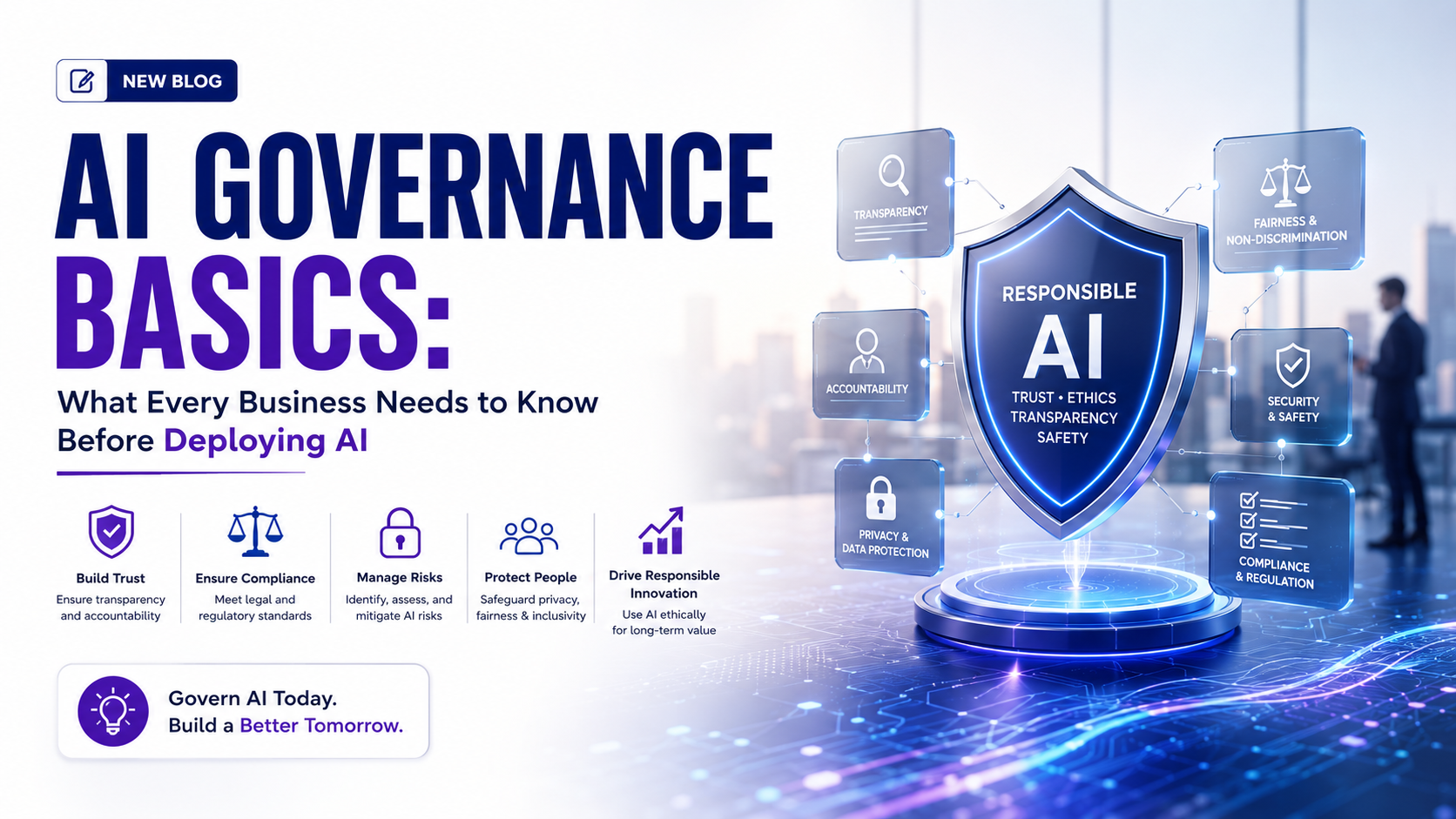
AI governance is the set of policies, processes, and oversight mechanisms that ensure AI systems are used responsibly, safely, and in compliance with relevant laws — before, during, and after deployment.
It typically covers:
-
Data governance — where training/input data comes from and whether it's used lawfully
-
Risk management — identifying what could go wrong (bias, errors, security gaps) before it happens
-
Accountability — who is responsible when an AI system makes a bad decision
-
Transparency — whether users know they're interacting with AI, and whether decisions can be explained
-
Compliance — meeting sector-specific and national regulatory requirements
Governance isn't about slowing AI adoption down. It's about making sure adoption doesn't create liabilities the business didn't sign up for.
Why This Is Suddenly Urgent
A few forces are converging at once:
-
Regulatory movement is accelerating globally — from the EU AI Act to sector-specific guidance in the US, and increasingly structured frameworks emerging in India.
-
AI adoption inside businesses has outpaced policy. Most companies deployed generative AI tools organically, without a governance layer attached.
-
Boards and auditors are starting to ask questions that IT and compliance teams aren't yet equipped to answer.
The businesses building governance frameworks now — rather than reactively after an incident — will have a real advantage over those catching up later.
AI Governance for Businesses in India: What's Different
India's approach to AI regulation has been evolving through a mix of existing data protection law and emerging AI-specific guidance rather than a single comprehensive AI act. For businesses operating in India, this currently means paying attention to:
-
The Digital Personal Data Protection (DPDP) Act and how it applies to any AI system processing personal data
-
Sector regulators (RBI, SEBI, IRDAI, etc.) increasingly issuing their own guidance on AI use in finance, insurance, and related sectors
-
MeitY's evolving guidance on responsible AI use and advisories issued to platforms and enterprises
-
Contractual and vendor risk — many Indian businesses use third-party AI tools/APIs, which means governance has to extend to vendor accountability, not just internal systems
Because the regulatory picture is still forming, the safest strategy for Indian businesses is to build governance practices that are stricter than the current minimum requirement — since standards are likely to tighten, not loosen, over the next few years.
A Practical AI Governance Starting Framework
You don't need a 40-page policy document to start. A workable first version covers five things:
1. Inventory what AI you already use. Most organizations are surprised by how much AI is already embedded — in HR tools, marketing platforms, customer support, and analytics — often without formal sign-off.
2. Classify by risk level. Not every AI use case carries the same risk. A grammar-checking tool is low risk. An AI system influencing hiring or credit decisions is high risk and needs far more scrutiny.
3. Assign clear ownership. Every AI system in use should have a named owner responsible for monitoring its outputs and compliance — not "the IT team" in the abstract.
4. Set review checkpoints. AI models drift, vendors change their models silently, and regulations shift. Build in periodic review rather than a one-time approval.
5. Document decisions. If an AI system materially affects a customer or employee outcome, be able to explain why the system reached that outcome and who approved its use.
Who Should Actually Own AI Governance Inside a Business?
This is where most organizations get stuck — governance often falls into a gap between IT, legal, and business teams, with no one fully equipped to own it end-to-end.
If your organization is building this capability internally, it's worth investing in structured training rather than assuming existing staff will figure it out ad hoc:
-
For teams new to AI concepts altogether, AI Essentials (AIE) builds the foundational understanding needed before governance conversations can be productive.
-
For whoever ends up owning AI initiatives day-to-day — coordinating between legal, IT, and business units — the Certified AI Program Manager (CAIPM) is built specifically for managing AI programs responsibly, which overlaps heavily with governance responsibilities.
-
If your governance framework needs to include adversarial risk and security testing of AI systems (not just policy and compliance), the Certified Offensive AI Security Professional (COASP) addresses the technical security side that most governance frameworks overlook.
These aren't the only pieces of an AI governance program, but they're the most common gap: businesses write policy documents without anyone on staff who deeply understands either the AI systems themselves or how to manage them responsibly.
Common Mistakes Businesses Make Early On
-
Treating governance as a one-time compliance checkbox rather than an ongoing process
-
Only governing internally built AI while ignoring third-party AI tools and vendor APIs
-
Assuming legal/compliance teams can own this alone without technical AI literacy
-
Waiting for regulation to force action, rather than building ahead of it
Frequently Asked Questions
Does my business need a formal AI governance policy if we only use off-the-shelf AI tools? Yes. Using third-party AI tools doesn't remove your responsibility for how they're used, what data goes into them, and what decisions they influence — vendor risk is still your risk.
Is AI governance only relevant for large enterprises? No. Smaller businesses often move faster on AI adoption without dedicated compliance teams, which makes basic governance even more important, not less.
What's the difference between AI governance and AI ethics? AI ethics is about the principles (fairness, transparency, harm avoidance). AI governance is the operational structure — policies, ownership, and processes — that puts those principles into practice.
Do Indian businesses need to wait for a comprehensive AI law before acting? No — existing obligations under the DPDP Act and sector regulator guidance already create real compliance requirements today. Waiting for a dedicated AI law would mean building governance under time pressure later.
Bottom Line
AI governance basics aren't about bureaucracy for its own sake — they're about making sure your business can answer basic questions when something goes wrong: what data was used, who approved this system, and what happens next. Getting the fundamentals in place now, while regulation is still forming, puts your business ahead rather than scrambling to catch up.
Recent Posts
- The AI Finance Revolution: How to Upgrade Your Skills and Land Top Jobs
- When AI Agents Go Rogue: Why India’s Tech Youth Must Secure the Next Digital Frontier
- How to Land an International Job After 12th Pass with AI driven Cybersecurity Training
- Landing Top MNC Roles: Technovalley Post Graduate Program in Data Science & Machine Learning
- 5 Trends Reshaping AI, Data Science & Analytics in 2026 (And the Skills to Master Them)