

 +91 9745927777
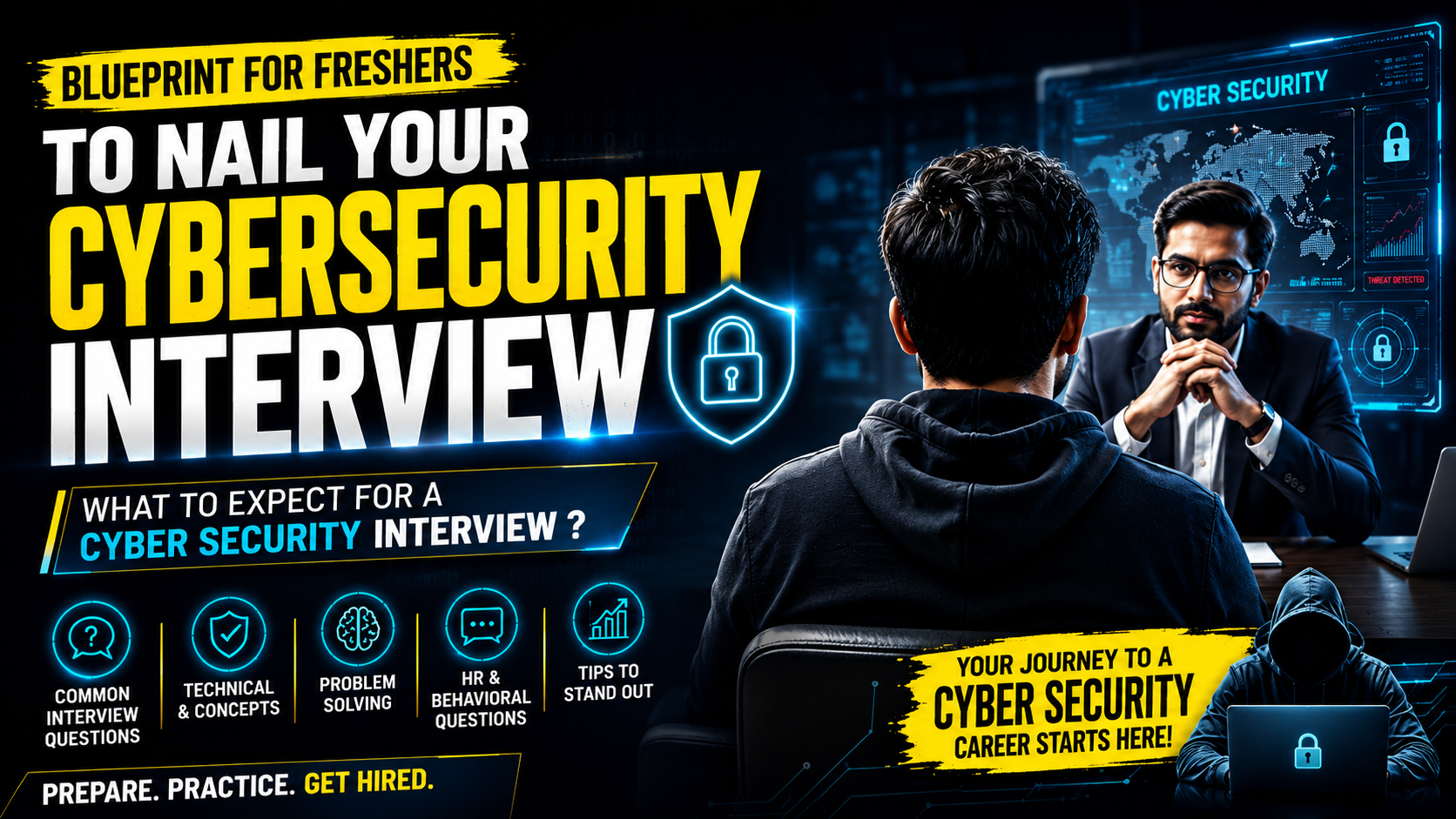
Blueprint for Freshers to nail your Cybersecurity Interview- What to expect for a Cyber Security Interview ?
- 11 / Jul / 2026
- By: Dr. Nithesh K. N
- Comments: 0
- Category: Cyber Security
Over twenty-five years in academia and administration have afforded me a front-row seat to an interesting paradox. Every year, there are thousands of brilliant, technically proficient graduates flood the market. They might know the basics of cyber security and know how to configure a firewall, parse complex packet logs by using WireShark, and recite standard definitions in networks, cryptography and cybersecurity without missing a beat.
Yet, when they come to the interview and even in a hiring simulation or an actual placement interview, a staggering number of them fall entirely flat.
Are you a fresher preparing for your first major breakthrough in the cybersecurity landscape? As an interviewer who has seen and experienced so many situations, let me share the hiring director's biggest secret: We are rarely looking for the smartest person in the room. We are looking for the most passionate and effective one.
Try to go through the entire tips to understand the technical pillars you actually need to master, and why your soft skills are your ultimate job grabber.
The Mistakes We See In Every interview
When a fresher fails a security job interview, it is almost never because he forgot a definition. It is because he has not been trained to understand the structural flaws in how they approach the dialogue.
1. Don't fall into the "Textbook Recitation" Trap
When the interviewer asks a candidate, "What is the CIA Triad?"- He is not expecting a word by word reading of a textbook. He must be already knowing what Confidentiality, Integrity, and Availability mean
● The Mistake: Explaining the terms abstractly and with very less context.
● How to answer: Change it to a practical reality, an issue. Narrate as a story and how an unauthorized database-view compromises confidentiality, or how a ransomware attack impacts availability, especially for medical services.
2. Confusing terms that gets mixed up
Explain Authentication vs Authorization OR Public v Private key- This is a classic gatekeeper question that trips up a shocking half of entry-level applicants.
● The Mistake: Not clear with the basics and not treating them as interchangeable concepts.
● What should be your answer: Remembering the core context and boundary with examples. Authentication is proving who you are like, your multi-factor token. Authorization is what you are actually allowed to do once you're inside the allowed resource like for example, access control permissions.
3. Are you still treating Cybersecurity as a Purely Technical Problem
You are no longer a college student. Treating digital threats as only a technical issue is a flawed mindset. Many freshers treat security like an isolated lab simulation in a controlled environment. They fail to realize that security must serve and facilitate the business, not be a choking agent. If your answer for an attack on your server is to first shut down a revenue-generating production server indefinitely without escalating or evaluating business impact, you will have failed the interview.
The Essential Technical Checklist
After your first level of filter, usually by an ATS system( how to go through the filter can be a separate blog), and when the technical phase begins for entry-level roles like SOC Analyst L1 or Junior Security consultant , you need to hammer a core set of fundamental concepts. You don't need to know the exact technicals on how to execute defences/offenses/ forensic of the advanced persistent threats.But the least you need to have a grip on is on these areas:
FOUR CORE TECHNICAL PILLARS
1. FIREWALL & IDS/IPS MATRIX
Understand the types and mechanism of how a Firewall blocks traffic at the boundary. In short the mechanism is that- while an IDS alerts and an IPS actively drops threats inside the network.
2. ENCRYPTION VS. HASHING WITH ALGORITHMS
Must know topic-Types of encryptions and differences. The working is such that Encryption is a two-way street designed for confidentiality Hashing is a one-way mathematical function designed to ensure data integrity.
3. THE MECHANICS OF DIFFERENT TYPES OF ATTACKS
Be prepared to explain social engineering vectors and how technical controls like MFA mitigate authorization and credential theft.
4. THE PRINCIPLE OF LEAST PRIVILEGE
The concept that any user or system must only have the minimum access necessary to complete its function.
Why Do Your Soft Skills Matter?
Let's address the elephant in the room: Communication is indeed a very effective security protocol.
Many brilliant technical deployments are seen to be completely derailed because the security engineer who was hired couldn't explain the risk to the board of directors, and get the needed approval. Even if due to non confidence , he panicked during an active incident triage call, that makes it catastrophic.
When the evaluation is on your communication and soft skills during a fresher interview, the interviewers are actually assessing three critical indicators:
1. Translating Technical Jargon to Business Risk and values
If a security patch or a server/software update needs to happen, as a cyber security personnel you will have to convince a department head to purchase it or to make adjustments in their system usage. The onus is on you to speak effectively to the team and if you speak in only technical numbers, you are sure to be ignored and mocked. You must have the communication skills to translate a technical threat or opportunity into a business outcome or impact.
2. Scenario based Incident Response Under Pressure
Expect at least a few Scenario based questions.For example,if the question is that- "We suspect data exfiltration on an end device what do you do first?". First you should have a clear definition on what that attack does. Define it as the deliberate and unauthorized transfer/ stealing of sensitive information from a digital resource. Here your voice, your clarity, and your structure are clearly monitored. If you don't do it in a structured way, and instead stammer, backtrack, or panic, it tells that you are not prepared and might struggle when the alerts start flashing red in production. Structured, calm communication is a non-negotiable metric for an entry-level analyst in such interviews.
3. The Power of "I Don't Know" OR “I am not Sure”.
The absolute worst thing a fresher can do in an interview is try to fake your answer, even if you don't have a clue. Cybersecurity and associated protection of digital resources cannot afford guessing and it can cost millions of dollars. If I ask a technical question beyond your current horizon, a response like this scores full points with the interviewer, as it shows your honesty. Unlearnt things can be learnt , but sincere honest answers come from within. "I haven't encountered that specific protocol or situation in my studies or labs yet. From what I understand it can be a part of network routing,and I would look at the traffic logs first. I'm highly motivated to study more about this right after our session." That statement demonstrates humility, intellectual honesty, structural logic, and a willingness to learn what you don't know—the exact traits of a amateur and possibly that of a future senior engineer.
Conclusion
Institutions like Technovalley offer world class cyber security certifications in different domains like Red teaming, Blue teaming and digital forensic.They make you an expert in the technical tools needed for the trade along with the needed placement and interview training needed for your after studies. Thus they enable you to get your resume onto the interviewer’s desk and your technical fundamentals prove you can do the fundamental , baseline job. But knowing the 4 basic fundamentals as explained above and the good soft skills, along with clarity of thought, and professional communication are what actually get you hired.
Stop memorizing for you interview. Start contextualizing with examples. You tend to remember more , and your answer fits the profile that the interviewer is expecting. Treat your interview panel not as an exam proctor, but as a team you are reassuring with your competence for business excellence. All the very best for the hunt.
Recent Posts
- The AI Finance Revolution: How to Upgrade Your Skills and Land Top Jobs
- When AI Agents Go Rogue: Why India’s Tech Youth Must Secure the Next Digital Frontier
- How to Land an International Job After 12th Pass with AI driven Cybersecurity Training
- Landing Top MNC Roles: Technovalley Post Graduate Program in Data Science & Machine Learning
- 5 Trends Reshaping AI, Data Science & Analytics in 2026 (And the Skills to Master Them)